Finance / July 24, 2026
How to Finance a Mobile Business Trailer
Loans, leases, down payments, lender requirements, and the cash-flow math behind funding a trailer without starving the business.
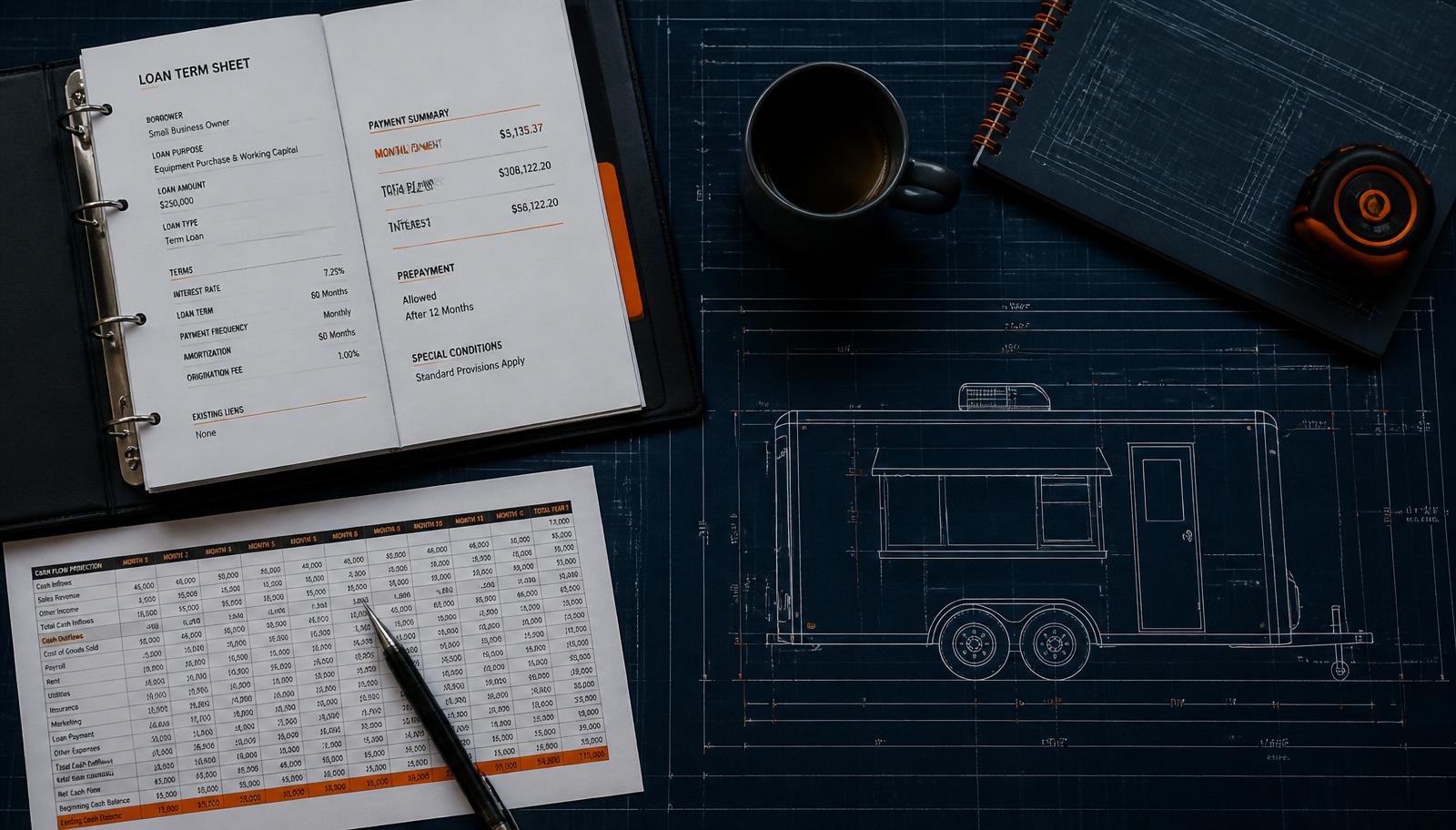
How to fund the durable asset, protect opening cash, compare offers, and build a payment the business—not hope—can support.
Financing a mobile business trailer is not simply a search for the lowest down payment or the smallest monthly bill. It is a capital-structure decision: which costs should be paid over time, which should be paid in cash, how much liquidity must remain after delivery, and how reliably the business can make the payment when sales are ordinary rather than exceptional.
That distinction matters because a trailer can be fully funded while the business inside it remains underfunded. An owner may secure the build and still lack cash for licensing, delivery, insurance, loose equipment, opening inventory, payroll, marketing, site deposits, or the first slow months. A lender approval solves only one part of the launch.
The goal is a financing plan that gets the right platform into service and leaves the business strong enough to use it.
Start With the Full Use of Funds—Not Just the Trailer Price
Before comparing lenders, turn the entire project into a sources-and-uses statement. "Uses" are everything that requires cash before the operation becomes self-sustaining. "Sources" show exactly where that cash will come from: an equipment loan, lease, term loan, owner contribution, investor equity, presales, or another documented source.
| Use of funds | What to include | Financing question to ask |
|---|---|---|
| Trailer and build | Base platform, fabrication, installed power, plumbing, climate, cabinetry, windows, and permanently installed systems. | Will the lender finance a custom build and staged vendor payments? |
| Operating equipment | Espresso system, refrigeration, point of sale, displays, furnishings, tools, screens, audio, or concept-specific equipment. | Must each item be on the vendor invoice or separately financed? |
| Delivery and ownership | Freight, sales or use tax, title, registration, inspection changes, graphics, and installation. | Which taxes, freight, and soft costs can be included in the amount financed? |
| Transportation and base | Compatible tow vehicle, hitch and brake equipment, secure storage, commissary, warehouse, or service base. | Does this require a separate vehicle loan, lease, or cash source? |
| Opening costs | Permits, insurance, professional fees, initial inventory, smallwares, uniforms, website, photography, and launch marketing. | Can the loan include working capital, or must these costs be paid in cash? |
| Operating reserve | Payroll, owner pay, rent or site fees, loan payments, fuel, replenishment, repairs, and marketing during the ramp. | How much unrestricted cash will remain after the down payment and closing? |
Seven Ways to Finance a Mobile Business Trailer
The right option depends on whether the business is new or established, what the lender will treat as collateral, how much working capital is needed, the owner's credit and experience, and whether the build requires deposits or progress payments. Many projects use more than one source.
| Financing method | Best fit | Potential advantage | Important tradeoff |
|---|---|---|---|
| Equipment loan | A trailer and identifiable business equipment with useful resale value. | Matches a long-lived asset with installment payments; ownership is generally clear once the loan is repaid. | May exclude permits, marketing, inventory, or reserve cash; asset and personal guarantees may secure the loan. |
| Equipment lease | Borrowers prioritizing cash preservation or a structure tied to equipment use. | May reduce upfront cash and provide a defined payment schedule. | End-of-term buyout, residual, early termination, ownership, and total cost vary widely. |
| Bank or credit-union term loan | Qualified borrowers with a strong plan, banking relationship, collateral, or established cash flow. | May cover a broader project than asset-only financing. | Startups may face heavier documentation, owner equity, collateral, and personal-guarantee requirements. |
| SBA 7(a) loan | Eligible U.S. small businesses needing equipment plus other allowable business costs. | Can support machinery, equipment, fixtures, supplies, and working capital through participating lenders. | SBA does not lend directly; underwriting, documentation, fees, collateral, and timing still matter. |
| SBA microloan | Smaller funding gaps, equipment, inventory, supplies, or working capital. | Loans are available through approved intermediaries for up to $50,000. | The average microloan is much smaller than the maximum and proceeds cannot pay existing debt or buy real estate. |
| Business line of credit | Established operations managing inventory, seasonal timing, or short cash-flow gaps. | Borrow, repay, and reuse within the approved structure. | Usually a poor primary source for a long-lived trailer; variable cost and short repayment can pressure cash flow. |
| Owner cash, equity, or presales | Closing a funding gap, preserving borrowing capacity, or proving demand. | Can reduce debt and demonstrate owner commitment without adding a scheduled payment. | Owner cash reduces liquidity; investors dilute ownership; deposits and presales create delivery obligations. |
Equipment Loan vs. Equipment Lease
An equipment loan generally finances an asset the business purchases, with the lender taking a security interest until the debt is repaid. An equipment lease gives the business the right to use the asset under a contract. Some leases lead to ownership through a stated purchase option; others include a meaningful residual or require return of the equipment.
Do not let the word "lease" or a low quoted payment answer the question. Read the end-of-term purchase option, residual value, documentation fees, interim rent, insurance requirements, early-termination rules, late charges, automatic-renewal language, personal guarantee, and total scheduled payments. Ask an accountant how the specific structure should be recorded and treated for tax purposes.
Where SBA-Backed Financing May Fit
An SBA-backed loan is made by a participating lender, not by the SBA itself. The SBA sets program guidelines and guarantees a portion of eligible loans, which can reduce lender risk. The 7(a) program can support multiple business purposes, including working capital, machinery and equipment, fixtures, and supplies. Most 7(a) loans can be substantially larger than a single trailer project, while SBA Express has a lower program maximum.
For a smaller gap, the SBA microloan program may be relevant. Microloans are available through nonprofit community intermediaries, can be used for working capital, inventory, supplies, furniture, fixtures, machinery, and equipment, and have a current maximum of $50,000. The SBA reports an average microloan of about $13,000, so it may be more useful as one layer of the project than as complete funding for a purpose-built platform.
SBA 504 financing is designed for major fixed assets and cannot be used for working capital or inventory. It may suit a larger facility or fixed-asset expansion, but it is usually not the first program to investigate for one startup trailer plus launch cash.
Can a Startup Get Mobile Trailer Financing?
Yes, some startups can qualify. The lender simply has less business history to evaluate, so the file usually depends more heavily on the owner. Personal credit, available cash, relevant experience, outside income, collateral, the quality of the plan, and evidence of real demand may carry more weight than they would for an established company. If you are still deciding whether to leave a W-2, our 90-day quitting-day playbook pairs directly with this financing guide.
| Startup borrower | Established-business borrower |
|---|---|
| Personal credit and personal financial position are often central. | Business tax returns, bank statements, and operating cash flow may carry more weight. |
| A clear owner contribution can demonstrate commitment and reduce lender exposure. | Retained business cash or a history of profitable operations may support the request. |
| Industry experience, training, permits, site letters, bookings, and presales help replace missing history. | Historical P&L, balance sheets, debt schedules, and location performance support repayment analysis. |
| Projections must explain traffic, capacity, pricing, direct costs, ramp time, and seasonality. | Projections should reconcile with actual trends and explain how the new asset adds capacity or revenue. |
| A personal guarantee is common in small-business lending. | A personal guarantee may still be required even when the company is established. |
There is no universal minimum credit score or automatic down-payment percentage across mobile trailer lenders. Programs, asset types, borrower profiles, and underwriting standards differ. A startup with strong credit and liquidity may see a different structure from a borrower with established revenue but recent credit problems.
How Much Down Payment Should You Expect?
Plan scenarios before you receive a quote. Current manufacturer and equipment-finance marketing commonly illustrates startup equity in the broad neighborhood of 10% to 30%, while some programs advertise lower or even no down payment for especially strong established borrowers. Those are market examples—not a standard, entitlement, or Venture Works financing offer.
| Planning scenario | $75,000 amount before down payment | Cash remaining question |
|---|---|---|
| 10% owner contribution | $7,500 cash / $67,500 financed | Would closing still leave a complete launch reserve? |
| 20% owner contribution | $15,000 cash / $60,000 financed | Does the lower payment justify using another $7,500? |
| 30% owner contribution | $22,500 cash / $52,500 financed | Is the business giving up cash it needs more than the lender does? |
A larger down payment reduces the amount borrowed and may improve approval or pricing, but it is not automatically the best business decision. Compare the interest saved with the value of keeping cash available for launch delays, seasonality, repairs, marketing, and working capital. A lower debt balance does not help if the business runs out of cash before the route or booking calendar matures.
What Lenders Evaluate
Credit history, capacity to repay, owner equity and liquidity, collateral and asset value, industry experience, business model quality, project clarity, existing obligations, and personal guarantees and insurance all shape a lending decision. Each carries different weight for a startup than for an established company.
Build a Lender-Ready Financing Package
The fastest way to weaken a financing request is to make the lender reconstruct the business from scattered documents. Prepare one coherent package in which the quote, budget, projections, and requested loan amount all agree.
| Category | Prepare |
|---|---|
| Borrower identity | Entity documents, EIN, ownership schedule, identification, business address, and business bank information. |
| Personal financial file | Authorization for credit review, personal financial statement, tax returns if requested, outside income, assets, liabilities, and explanations of material credit events. |
| Business financial file | Historical tax returns if available, recent bank statements, year-to-date P&L, balance sheet, AR/AP detail, and debt schedule. |
| Project file | Signed or current quote, specifications, equipment schedule, vendor contact, deposit and progress-payment requirements, delivery estimate, taxes, freight, and insurance quote. |
| Plan and projections | Business plan, sources and uses, opening budget, 24-month monthly cash-flow forecast, assumptions, break-even, downside case, and owner-pay treatment. |
| Market evidence | Customer interviews, letters of intent, site discussions, event pipeline, deposits, presales, contracts, competitor review, and relevant owner experience. |
| Compliance plan | Permit map, anticipated approvals, base or commissary arrangements, towing plan, and timeline to legal operation. |
How to Calculate a Mobile Trailer Loan Payment
A payment depends on the amount financed, interest rate, term, fees, and payment structure. APR is generally more useful than the interest rate alone because APR reflects the rate plus certain additional finance charges. Ask every provider to show the total amount financed, all fees, total scheduled payments, and any final buyout or balloon.
The example below uses a fully amortizing $75,000 loan at a hypothetical 10% annual rate with monthly payments and no fees. It is payment math—not a lender quote, approval estimate, or current market rate.
| Illustrative term | Monthly payment | Total scheduled payments | Total interest |
|---|---|---|---|
| 60 months | $1,593.53 | $95,611.70 | $20,611.70 |
| 72 months | $1,389.44 | $100,039.52 | $25,039.52 |
| 84 months | $1,245.09 | $104,587.46 | $29,587.46 |
The longer term lowers the required monthly payment but raises total interest in this illustration. The right term should fit both the useful life of the asset and a conservative operating forecast. It should not simply postpone a payment the business cannot support.
Translate the Payment Into Required Sales
A $1,389 payment does not require only $1,389 in sales because each sale has direct costs. If the business retains a 65% contribution margin after product and other sale-driven costs, it needs approximately $2,138 in additional monthly sales to create $1,389 of contribution.
| Illustrative input | Value |
|---|---|
| Monthly trailer payment | $1,389.44 |
| Contribution margin after variable costs | 65% |
| Additional monthly sales required | About $2,138 |
| At a $10 average transaction | About 214 transactions per month |
| Across 22 operating days | About 10 additional transactions per day |
An Illustrative Sources-and-Uses Plan
This example shows why financing the durable asset and preserving launch cash are separate jobs. Replace every line with actual quotes and local costs.
| Illustrative use | Amount | Illustrative source |
|---|---|---|
| Trailer and installed operating systems | $85,000 | Equipment financing plus owner asset contribution |
| Loose equipment, smallwares, and graphics | $15,000 | Owner cash or eligible term-loan proceeds |
| Delivery, tax, title, and registration | $6,000 | Loan if eligible; otherwise owner cash |
| Permits, insurance, and professional costs | $4,000 | Owner cash |
| Opening inventory and launch marketing | $5,000 | Owner cash |
| Operating reserve | $20,000 | Unrestricted owner cash or eligible working capital |
| Total project | $135,000 | $90,000 financing + $45,000 owner cash |
In this scenario, the owner's $45,000 is not treated as one giant down payment. It covers the asset gap, costs the equipment lender may exclude, and a deliberate reserve. The actual split depends on lender eligibility, taxes, the build contract, and the risk in the operating plan.
How to Compare Financing Offers
Ask providers to quote the same project and then compare the complete obligation. A small payment can hide a longer term, upfront fees rolled into principal, frequent withdrawals, a large final buyout, or a structure that starts before the trailer is earning.
| Term to compare | Question to ask |
|---|---|
| Amount financed | What exact costs are included, and how much cash must I bring to closing and delivery? |
| Rate and APR or equivalent cost | Which fees are included, and what is the complete cost of capital? |
| Payment | How much, how often, when does it begin, and can it change? |
| Term and total repayment | How many payments, what is the total, and is there a balloon, residual, or purchase option? |
| Fees | What are the documentation, origination, closing, filing, inspection, interim-rent, late, and termination charges? |
| Prepayment | Can I pay early, and does doing so actually reduce the remaining finance charge? |
| Collateral and lien | Which trailer, equipment, accounts, or other assets secure the obligation? |
| Personal guarantee | Who guarantees the debt, and is the guarantee unlimited? |
| Disbursement | Will the provider fund deposits and milestones, pay the vendor directly, and hold back money until delivery? |
| Default and remedies | What triggers default, cure rights, repossession, cross-default, or additional fees? |
Financing a Custom Trailer Build
Custom builds create a timing issue that off-the-lot equipment does not: the manufacturer may require a deposit and progress payments before the finished collateral exists. Confirm the financing process before signing a nonrefundable build agreement. Ask when the lender can issue approval and how long it stays valid, whether a deposit can be reimbursed or financed, whether funds go to the borrower or directly to the manufacturer, what documents release each draw, when interest or full payments begin, and how title, lien filing, insurance, acceptance, and transport will be coordinated.
A lender that understands commercial equipment and staged fabrication may be easier to coordinate with than a provider expecting a finished serial-numbered asset at closing. The cheapest indicative quote is not useful if the funding mechanics do not match the build.
Financing Mistakes That Make a Mobile Business More Fragile
| Mistake | Better decision |
|---|---|
| Budgeting only the trailer price | Fund the complete path to legal operation plus an intentional cash reserve. |
| Using every available dollar as a down payment | Model interest savings against the risk of opening without working capital. |
| Choosing the lowest monthly payment | Compare APR or equivalent cost, term, total repayment, fees, and any final buyout. |
| Applying before the project is defined | Bring a detailed quote, sources and uses, equipment list, timeline, and forecast. |
| Forecasting only the dream month | Make repayment work in a conservative month and test delays, weather, and seasonality. |
| Ignoring the personal guarantee | Understand exactly which owners and assets stand behind the obligation. |
| Using short, expensive daily-debit capital for a long-lived asset | Match repayment frequency and term to the asset and the business cash cycle. |
| Treating a tax deduction as affordability | Make the purchase work before possible tax benefits and confirm treatment with a tax professional. |
| Mixing personal and business money | Use a business account and bookkeeping system so lenders and owners can see true performance. |
Merchant cash advances and similar receivables-purchase products deserve particular caution. They can use frequent withdrawals and factor-rate pricing that is difficult to compare with an amortizing loan. Fast funding does not make a short, high-cost structure appropriate for a trailer expected to serve the business for years.
When Financing Makes Sense—and When to Wait
| Finance when… | Pause and strengthen the plan when… |
|---|---|
| The customer, offer, route or booking model, and pricing are specific. | The market evidence consists mainly of compliments and social-media interest. |
| Local approval requirements are mapped and the intended build can satisfy them. | You do not yet know where the trailer can legally operate or what the regulator will require. |
| A conservative forecast covers the payment, owner pay, taxes, maintenance, and reserve. | The target-month forecast barely covers debt or excludes owner compensation. |
| The full project—not only the platform—has committed funding. | Closing would consume the cash needed for permits, inventory, payroll, or delays. |
| The platform solves a measured capacity, access, or customer-experience need. | The project is being used to postpone customer validation or operational decisions. |
How Venture Works Helps Create a Lender-Ready Project
A credible financing request starts with a credible project. Lenders need to understand what is being purchased, what is permanently installed, how the finished platform will be used, how the manufacturer is paid, and when the asset can enter service.
Venture Works turns a mobile business concept into a defined configuration and project quote. THE MORNING RUSH is designed around coffee and espresso service. THE TAPHOUSE supports beverage and event operations. THE OUTFITTER creates a mobile retail environment. THE PARLOR brings professional personal-service space to the customer. THE DIGITAL ARENA and THE SOCIAL CLUB support bookable entertainment and hospitality. THE CUSTOM FIT begins with the workflow when the business needs something more specific.
Bring the operating model, local requirements, equipment list, utility needs, target capacity, and available funding range to the conversation. Venture Works can help translate those inputs into the configuration and documentation you can take to lenders. Financing approval, rates, terms, and program eligibility are determined by the financing provider.
Ready to define the platform your financing plan needs to support? Start a no-obligation conversation with Venture Works.
Final Takeaway
The best mobile business trailer financing is not necessarily the fastest approval, the smallest down payment, or the lowest monthly number. It is the structure that matches the asset, funds the complete launch, preserves enough liquidity for reality, and produces a payment the business can support in a conservative month.
Define the project first. Build a lender-ready file. Compare the whole obligation. Translate the payment into required sales. Protect the operating reserve. Then use the financed platform for what it is meant to be: a durable tool for reaching customers, fulfilling bookings, and creating revenue. When you're ready, configure your VWMT-Series platform or send us your project details.
Frequently Asked Questions
Common Questions
- Can I finance a mobile business trailer?
- Potentially. Common options include equipment loans, equipment leases, bank or credit-union term loans, SBA-backed loans, and a combination of financing and owner cash. Approval and structure depend on the borrower, business, asset, lender, and intended use.
- Can I get food trailer or coffee trailer financing as a startup?
- Some startups qualify, but without business history the lender may rely more heavily on personal credit, liquidity, relevant experience, owner equity, collateral, projections, and evidence such as locations, contracts, bookings, or presales.
- What credit score is needed to finance a business trailer?
- There is no universal score across all programs. Each lender sets underwriting standards and considers more than a score, including credit history, cash, debt, business experience, collateral, and repayment capacity. Ask providers whether they can prequalify with a soft credit inquiry before authorizing a hard pull.
- How much is the down payment on a mobile business trailer?
- It varies. Current industry examples commonly discuss a broad 10% to 30% planning range for startups, while some strong established borrowers may see lower requirements. Treat those figures as shopping scenarios, not guaranteed terms, and preserve enough cash to open and operate.
- Can an SBA loan finance a mobile business trailer?
- An eligible SBA 7(a) loan may be used for machinery, equipment, fixtures, supplies, working capital, and other allowable business purposes. The loan is made by a participating lender, which determines underwriting and structures the request under SBA rules.
- Can equipment be included with the trailer financing?
- Possibly, especially when equipment is identified on the quote and installed in or sold with the platform. Loose equipment, inventory, freight, taxes, permits, and working capital may be treated differently. Confirm eligible costs before signing purchase agreements.
- Is it better to lease or finance a mobile business trailer?
- Neither is automatically better. Compare upfront cash, ownership, total payments, fees, end-of-term purchase option or residual, cancellation rules, useful life, tax and accounting treatment, and the effect on cash flow. Review the actual contract, not only the payment.
- Can financing include working capital?
- Some term-loan and SBA structures may include eligible working capital, while asset-only financing may not. Ask the lender to identify every eligible use and keep a separate reserve if the financing cannot cover opening and ramp costs.
- How long does trailer financing take?
- Timing ranges from relatively fast equipment decisions to longer bank or SBA processes. A startup, custom build, incomplete documentation, appraisal, collateral review, or staged disbursement can add time. Ask about approval validity, closing conditions, and when funds can actually reach the manufacturer.
- Can I finance a used mobile business trailer?
- Potentially, but age, condition, title, valuation, remaining useful life, modifications, inspection, and seller documentation may affect eligibility, down payment, and term. Also budget for repairs and any changes required by current local regulations.
- Are trailer loan payments tax-deductible?
- The principal portion of a loan payment is generally not simply deducted as an operating expense. Interest, depreciation, lease payments, and asset-expensing rules may receive different treatment depending on the structure and the taxpayer. Have a qualified tax professional review the specific agreement before relying on a tax benefit.