Compliance / July 24, 2026
What Permits and Licenses Does a Mobile Business Need?
A practical framework for finding the agencies, approvals, inspections, and location rules that apply before a mobile business opens.
The practical way to map business, operator, unit, location, and event approvals before the build becomes expensive.
A mobile coffee trailer, traveling boutique, barbershop, gaming lounge, event bar, and product showroom may all be “mobile businesses,” but regulators do not begin with the marketing category. They begin with the activity: preparing food, selling taxable goods, serving alcohol, performing a licensed service, employing workers, occupying a site, using propane, generating wastewater, or operating a commercial trailer.
Mobility adds another layer. The business may cross a city line between breakfast and lunch, operate on private property during the week, attend a public festival on Saturday, and store the unit in a different county overnight. Each move can change which authority, property rule, event standard, or operating definition applies.
The safest planning method is not to search for one perfect national checklist. It is to build a permit map for the actual business and have the responsible agencies confirm it before final design and fabrication. If you are still at the concept stage, start with how to start a mobile business and come back here before you commit to a build.
Think in Layers: The Mobile Business Permission Stack
A “license” often authorizes a person or business to perform an activity. A “permit” often authorizes a unit, system, site, event, or method of operation. Those words are not used consistently across the country, so focus on what each approval controls rather than its label.
| Layer | What it may govern | Questions to resolve |
|---|---|---|
| Business identity and tax | Entity registration, assumed name, federal or state tax IDs, sales-tax registration, local business license. | Who is operating and collecting revenue? Where is the business based and registered? |
| Activity or service | Food service, retail, alcohol, barbering, cosmetology, wellness, entertainment, regulated products, or another licensed trade. | Is the activity regulated, and does the business or individual need a credential? |
| Mobile unit | Plan review, construction, plumbing, electrical, ventilation, equipment, sanitation, fire protection, title, and registration. | Which agency reviews the trailer, and what must it approve before fabrication or operation? |
| People | Food-protection training, professional licenses, responsible-person credentials, employee requirements, or background checks. | Must a credentialed person be present whenever the business operates? |
| Location | Zoning, vending, parking, right-of-way, private-property permission, setbacks, hours, noise, signs, restroom access, and utilities. | Is this specific unit and activity allowed at this exact site and time? |
| Event | Temporary-event permits, organizer approval, vendor documents, inspections, fire rules, certificates of insurance, and event fees. | Does the event create a separate approval even if the unit is already licensed? |
| Ongoing operation | Renewals, inspections, recordkeeping, taxes, employee safety, accessibility, waste handling, and change approvals. | What must be renewed, posted, carried, reported, or reapproved? |
Why Requirements Vary So Much
The U.S. Small Business Administration states the principle plainly: license and permit requirements and fees vary with business activities, location, and government rules. Food businesses add another source of variation. The FDA Food Code is a model that state, local, tribal, and territorial regulators may adopt or adapt; it is not one automatic national permit system.
Two neighboring jurisdictions may use similar safety principles but assign them to different departments, define “mobile” differently, require different supporting facilities, or use different approval sequences. One may recognize an operating license issued elsewhere in the state while still inspecting the unit at events. Another may separately license the operator, permit the unit, limit public-street permits, and regulate where the unit is cleaned and stored.
This is why online statements such as “you need a food truck permit” are rarely complete. The question is: which permit, for which person or unit, issued by which authority, valid in which place, for which menu or service, during which operating period?
Who to Contact When Planning a Mobile Business
Start with the agencies that control the activity and the first intended operating location. Titles vary, but the following map will usually identify the right conversation.
| Contact | Why contact them | What to request |
|---|---|---|
| State business portal or Secretary of State | Entity formation, assumed names, statewide registrations, and links to regulated activities. | Formation requirements and the state’s official license or business-resource directory. |
| State revenue or taxation agency | Sales tax, seller permits, withholding, and other state tax accounts. | Registration sequence, filing frequency, and treatment of mobile or multi-jurisdiction sales. |
| City or county business-licensing office | General business, vendor, peddler, mobile-business, or local operating licenses. | A complete local checklist and the lead department for mobile operations. |
| Planning, zoning, or code enforcement | Whether the activity and unit may occupy a private site or public area; hours, signs, setbacks, parking, and duration. | Written site classification and any zoning, use, parking, or temporary-use application. |
| Local or state health department | Food, beverage, sanitation, water, wastewater, commissary or base, menu, and unit plan review. | Current mobile-unit application, plan-review guide, equipment standards, and inspection sequence. |
| Fire marshal or fire-prevention bureau | Propane, cooking, ventilation, suppression, generators, batteries, exits, extinguishers, and event placement. | Mobile-unit checklist, required drawings, inspection timing, and accepted certifications. |
| DMV, BMV, or vehicle agency | Title, VIN, trailer or commercial registration, plates, weight class, and inspection where applicable. | Requirements for the exact trailer, tow vehicle, ownership, and business use. |
| Professional or product regulator | Barbering, cosmetology, massage, health services, childcare, alcohol, tobacco, cannabis, or other regulated work. | Business, facility, and individual-license rules for a mobile setting. |
| Venue or event organizer | Property access, vendor approval, power, water, waste, insurance, arrival, parking, and event-specific inspections. | Vendor packet, site plan, insurance limits, deadlines, and responsibility matrix. |
For food operations, the local health department is often the most important early call. For a salon or barbershop, begin with the professional licensing board and local site authority. For a mobile bar, begin with the state alcohol regulator and the jurisdictions and venues where service is planned. For a public-street retail concept, vending, right-of-way, and zoning offices may drive the model.
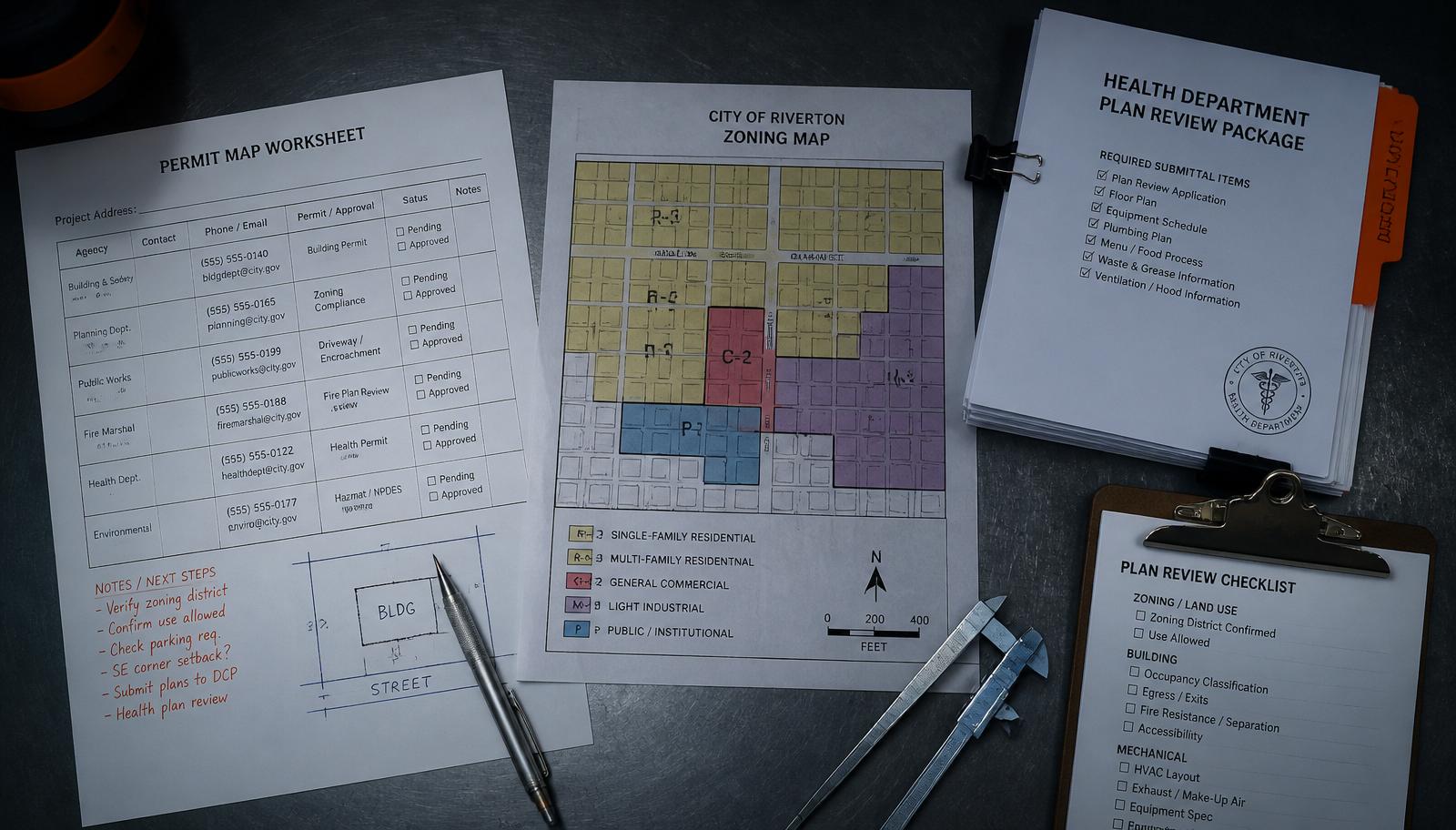
A 10-Step Permit Research Process
1. Define the regulated activity precisely
Write the opening menu, services, products, equipment, staffing, customer capacity, utilities, and operating hours. “Coffee trailer” is not enough: espresso and packaged pastries may be reviewed differently from cooking eggs, making ice, filling growlers, or preparing food off-site.
2. Choose the primary operating pattern
Identify whether the business will follow a recurring route, remain at one private site, attend temporary events, operate by appointment, or combine several channels. A unit that stays in one place may be classified differently from one that routinely moves.
3. List every intended jurisdiction
Map the state, counties, cities, health districts, fire districts, and venue types involved in the first year. Include the business base, overnight storage, commissary or service facility, and the places where sales occur.
4. Identify the lead agency in each place
Call the city or county business office and ask who coordinates mobile businesses of this type. Then confirm the answer with the agency that regulates the core activity, such as health, alcohol, or a professional board.
5. Ask for current written materials
Collect the current application, plan-review packet, inspection checklist, fee schedule, code references, zoning or site form, event rules, and renewal information. Record the publication or revision date.
6. Request classification before final design
Ask how the authority classifies the proposed unit and activity: mobile, temporary, seasonal, catering, retail, personal service, commercial trailer, or another category. The classification may control which plans, facilities, and locations are allowed.
7. Map dependencies and lead times
Some applications require entity documents, tax registration, a commissary agreement, insurance, operator training, a vendor contract, or a completed unit inspection. Put those dependencies in the order they must occur.
8. Complete plan review before fabrication when required
Submit the menu or service description, floor plan, equipment, utilities, materials, safety systems, and operating procedures before ordering or modifying the unit. Written review is much cheaper than rebuilding after inspection.
9. Schedule inspections and opening approvals
Confirm which inspections occur at the manufacturer, base, licensing jurisdiction, first event, or operating site. Ask what must be functional, filled, connected, labeled, or available for the inspection.
10. Build a renewal and change-control system
Track expiration dates, renewal windows, posted documents, staff credentials, inspection records, site agreements, and insurance certificates. Ask which menu, equipment, layout, ownership, location, or operating changes require notice or reapproval.
Questions to Ask Every Agency
| Ask this | Because it determines |
|---|---|
| How do you classify this exact business, unit, and activity? | Which code section, application, and plan requirements apply. |
| Do you license the business, the operator, the unit, the site, or more than one? | How many separate approvals the project actually needs. |
| Does the approval cover the state, county, city, or only one address or event? | Whether a route or event schedule is legal as planned. |
| Are private property, public streets, parks, routes, and events treated differently? | Where the unit can realistically earn revenue. |
| Is plan review required before purchase, fabrication, or material alteration? | When the build can safely begin. |
| Which menu items, services, processes, utilities, or equipment change the classification? | Which design decisions carry regulatory cost. |
| Is a commissary, commercial kitchen, depot, wastewater agreement, or restroom required? | What support facilities must be secured before opening. |
| Which equipment standards, listings, drawings, or specifications must be submitted? | What documentation the manufacturer needs to provide. |
| Which inspections are required, who schedules them, and where do they repeat? | The real opening timeline. |
| What must be posted or carried, and which credentialed person must be present? | Daily operating and staffing obligations. |
| What are the dependencies, lead times, fees, renewal dates, and transfer rules? | The order of operations and the renewal calendar. |
Get Plan Review Before the Build Becomes Expensive
A purpose-built trailer can make compliance easier to organize because the operating systems, equipment, surfaces, storage, and utilities can be designed as one documented workspace. That advantage disappears if the unit is built around assumptions the reviewing agency does not accept. Bring your agency checklist to the Venture Works configurations before anything is fabricated.
| Plan-review input | Why it matters |
|---|---|
| Menu, products, or services | Determines risk, required equipment, sanitation, staff credentials, and whether the proposed classification fits. |
| Scaled floor plan and workflow | Shows service windows, clearances, customer and employee movement, storage, sinks, exits, and equipment placement. |
| Equipment schedule | Identifies model numbers, certifications or listings, heat loads, refrigeration, sanitation, and installation needs. |
| Power and fuel systems | Documents shore power, generator, battery, propane or other fuel, loads, ventilation, shutoffs, and protection. |
| Water and wastewater | Shows supply source, tanks, pumps, heaters, sinks, backflow protection, waste capacity, and disposal plan. |
| Materials and finishes | Helps reviewers evaluate cleanability, durability, moisture resistance, fire performance, and the intended activity. |
| Ventilation and fire protection | Connects cooking or heat-producing equipment to exhaust, suppression, extinguishers, detection, and clearances. |
| Base and operating procedures | Explains storage, cleaning, restocking, commissary or depot use, overnight parking, staff sanitation, and waste handling. |
| Trailer and transport data | Documents VIN or title information, dimensions, weight ratings, installed payload, towing assumptions, and site access. |
If the unit will serve the public, include accessibility in the planning conversation. Businesses open to the public may have obligations related to equal access to goods and services. The correct solution can involve the service approach, route, counter, communication, site, or other reasonable measures, so review the actual concept and location rather than relying on one universal window height.
Permits Change With the Mobile Business Concept
| Concept | Likely early contacts | Common triggers to investigate |
|---|---|---|
| Coffee or food | Health department, local business office, zoning, fire marshal, tax agency, DMV or BMV. | Menu, food preparation, sinks, water, wastewater, refrigeration, commissary, generator, propane, vending location, food-safety training. |
| Mobile bar or beverage | State alcohol regulator, local licensing, venue, insurer, health and fire agencies as applicable. | Who buys, owns, transports, stores, and serves alcohol; event type; caterer or host arrangement; age controls; liquor liability. |
| Retail or boutique | Tax agency, local business and vending offices, zoning, venue, vehicle agency. | Sales-tax collection, public vending, private-site use, merchandise security, signs, fitting area, accessibility, event rules. |
| Barber or personal service | State professional board, health or sanitation authority, local business and zoning offices. | Individual and establishment licenses, mobile-facility rules, sanitation, water, waste, privacy, records, staff credentials. |
| Gaming, lounge, or entertainment | Local business and zoning offices, fire marshal, venue, insurer, tax agency. | Occupant capacity, egress, power, batteries, climate, noise, customer access, event permissions, amusement or prize rules. |
| Custom professional concept | The regulator for the core activity plus local business, zoning, fire, vehicle, and site authorities. | Training, wellness, pet services, education, demonstrations, medical or regulated services, specialized equipment, privacy, accessibility. |
These are research prompts, not a permit list. A packaged-product coffee unit may have a different path from a full espresso and breakfast operation. A dry-hire mobile bar may be treated differently from a company selling or serving alcohol. A retail trailer on a booked private event may face different location rules from the same trailer vending at the curb.
Location Permission Is a Separate Decision
Where the unit earns is often as important as what happens inside it. Build a location plan early enough that zoning, parking, access, restrooms, utilities, and event restrictions can shape the business model.
| Operating setting | What may be different |
|---|---|
| Recurring private-property site | Owner agreement, zoning or temporary-use approval, parking and circulation, duration limits, restroom access, utilities, waste, signs, hours, and whether the unit becomes a fixed use. |
| Public street or right-of-way | Vending license or permit, permit caps or routes, restricted streets, metering, distance rules, parking law, pedestrian clearance, service-side orientation, and time limits. |
| Festival or temporary event | Organizer credentialing, event or temporary food approval, fire inspection, vendor fee, certificate of insurance, arrival window, site assignment, generator rules, and waste plan. |
| Appointments at customer sites | Professional-service rules, property permission, home-occupation or workplace rules, privacy, accessibility, parking, and whether each jurisdiction recognizes the mobile license. |
| Multi-city route | License portability, separate local business or vending registrations, sales tax, health or fire inspections, route restrictions, and renewal calendars. |
Trailer vs. Food Truck: What a Trailer Can Simplify
A trailer and a self-propelled food truck may be regulated similarly for health, fire, food, vending, or professional activity. Choosing a trailer does not create an automatic permit exemption. The practical advantages are operational and mechanical — and those advantages can make the compliance plan easier to maintain.
The compliance benefit is control: the operator can present one purpose-built plan, keep the business workspace separate from tow-vehicle maintenance, and configure utilities and equipment around known agency requirements. The operator must still verify commercial trailer registration, towing and weight rules, insurance, site access, and every approval tied to the activity. For the wider tradeoff, see why mobile beats brick-and-mortar.
Two Jurisdictions, Two Very Different Paths
The following snapshots are included only to show how the framework changes by place. They are not instructions for every operator, and current local requirements should always be verified directly with the agencies involved.
Example 1: Cuyahoga County, Ohio — plan review, local licensing, broader mobility
Cuyahoga County Board of Health’s 2026 new mobile unit materials require plan review before a new mobile unit operates. The published sequence moves from plan approval to a license application and then a final inspection. The application asks about the menu, equipment, construction, water, wastewater, power, storage location, and operating procedures — the same inputs that should be resolved before a build is finalized.
The county’s 2026 temporary-event guidance says prelicensed and inspected mobile food service operations may operate throughout Ohio and may be inspected at participating events. Ohio’s administrative definition also ties “mobile” status to routine movement and says an operation remaining at one location for more than 40 consecutive days is no longer a mobile food service operation.
Planning lesson: one state may create meaningful portability for a properly licensed mobile operation, but the home health district, event inspections, local site rules, and the definition of mobile still matter.
Example 2: New York City — the person, the unit, and the location
New York City’s official mobile food vendor guidance separates the vendor from the unit: a food vendor needs a vendor or supervisory license, and the mobile unit needs a permit. The city also distinguishes public-street permits, restricted-area permits for qualifying private property, and temporary-event permissions. Some public-street permit paths use limits, supervisory licensing, or waiting-list processes, while the restricted-area path is structured differently.
NYC also addresses where permitted carts and trucks are cleaned, serviced, and stored, and it publishes restricted-street and inspection guidance. The result is not one “food truck license”; it is an interdependent system involving the operator, unit, operating area, food source or commissary, inspection, and the kind of location.
Planning lesson: in a dense city, the right to perform the activity and the right to use a particular public or private space may be separate, scarce, and operationally significant.
Build a Permit Matrix Before You Commit
A one-page matrix prevents missed dependencies and lets the manufacturer, owner, venue, and agencies work from the same facts. Create one row for each approval in each jurisdiction.
| Field | What to record |
|---|---|
| Jurisdiction and agency | State, county, city, district, venue, or property authority and the department that owns the approval. |
| Approval | Exact name of license, permit, registration, plan review, inspection, credential, agreement, or exemption. |
| Controls | Business, person, unit, activity, site, event, equipment, or ongoing operation. |
| Applies to | Specific menu, service, unit, site, operating dates, and geographic coverage. |
| Dependencies | Entity, tax account, plan approval, training, insurance, commissary, site letter, equipment, or inspection. |
| Submission and lead time | Application method, deadline, review time, inspection scheduling, and opening constraint. |
| Evidence | Document to retain, number, decal, certificate, posted item, approval letter, or inspection report. |
| Renewal and change triggers | Expiration, renewal window, transferability, ownership change, menu or equipment change, new site, or alteration. |
| Contact and verification date | Name, phone or email, date confirmed, source URL, publication date, and next follow-up. |
Common Permit-Planning Mistakes
| Mistake | Better approach |
|---|---|
| Buying the unit before confirming classification | Define the activity and operating model, then obtain the reviewing agency’s current plan requirements. |
| Assuming “mobile” means permitted everywhere | Map the geographic coverage of every approval and investigate each city, county, site, and event. |
| Treating private-property permission as the final approval | Confirm zoning, use, parking, health, fire, business, alcohol, and event rules for the parcel. |
| Submitting a floor plan without the menu or workflow | Show what will be sold, how it moves through the operation, and what every system and piece of equipment supports. |
| Relying on an event organizer to handle everything | Use the vendor packet to divide responsibility and confirm what remains the operator’s obligation. |
| Ignoring the base, storage, or commissary | Ask where the unit may be stored, cleaned, serviced, supplied, and emptied when it is not selling. |
| Changing equipment or service after approval without asking | Use change control and obtain written guidance before material alterations or menu expansion. |
| Tracking approvals in email only | Maintain a permit matrix, renewal calendar, inspection file, and current documents inside the unit. |
| Copying another operator’s checklist | Use competitors for questions, then verify every answer with the authority responsible for your business. |
How Venture Works Supports a Better Approval Process
Venture Works does not replace the agencies that license the owner, approve the activity, or authorize the operating site. The owner remains responsible for identifying and satisfying the rules that apply to the business.
What Venture Works can do is begin with better inputs. Bring the current agency checklist, plan-review comments, menu or service definition, equipment requirements, utility standards, workflow, capacity, and operating model to the configuration process. Those materials can then shape the floor plan, installed systems, equipment integration, storage, openings, finishes, and documentation.
THE MORNING RUSH provides a purpose-built starting point for coffee and espresso. THE TAPHOUSE supports beverage and event service. THE OUTFITTER creates a mobile retail environment. THE PARLOR is designed around personal service. THE DIGITAL ARENA and THE SOCIAL CLUB support entertainment and hospitality. THE CUSTOM FIT starts with the work when the concept or local requirements demand something more specific. Compare all seven configurations once your reviewing agency has confirmed the classification.
Final Takeaway
The question is not simply “What permit does a mobile business need?” The better question is “Which authority controls each part of this business, unit, person, site, and event — and in what order must those approvals happen?”
Define the activity. Map the jurisdictions. Find the lead agencies. Collect current written requirements. Confirm classification. Complete plan review before expensive fabrication. Track inspections, renewals, and changes. Then design the trailer around the operation the authorities have actually reviewed. This article is general information, not legal advice — verify every requirement with the responsible agency.
Frequently Asked Questions
Common Questions
- Does every mobile business need a business license?
- Many jurisdictions require some form of business registration or local operating license, but the name and scope vary. The activity may also require separate state, county, city, professional, health, fire, tax, unit, or site approvals. Ask the local business office and the agency regulating the core activity.
- Do food trailers need the same permits as food trucks?
- Often they are regulated under the same or similar mobile-food definitions, but not always. A trailer may have different title, registration, towing, site, or inspection details. Confirm how the health department, fire marshal, zoning office, and vehicle agency classify the exact unit.
- Can I operate a mobile business on private property?
- Possibly, with the owner’s written permission and any required local approvals. Private property does not automatically eliminate zoning, business, health, fire, alcohol, parking, professional, restroom, waste, sign, or temporary-use rules.
- Do I need a separate permit in every city or county?
- It depends on the approval and jurisdiction. Some licenses may have statewide or district-wide reach; other business, vending, site, health, fire, tax, or event requirements may be local. Ask the issuing agency exactly where the approval is valid and what another jurisdiction may still inspect or require.
- What if my mobile business does not sell food?
- Non-food concepts still need a permit map. Retail, barbering, cosmetology, wellness, alcohol, entertainment, pet services, training, healthcare, and other activities can trigger professional, tax, zoning, fire, accessibility, vehicle, business, or event requirements.
- Does a mobile food business always need a commissary?
- No universal answer applies. Some jurisdictions require an approved commissary, depot, commercial kitchen, or servicing area depending on the menu and unit. Others allow an alternative facility or self-contained operation under defined conditions. Ask the reviewing health department before choosing a base or designing tanks and storage.
- Is a trailer easier to permit than a self-propelled food truck?
- Not automatically. The activity, equipment, location, and operator may face the same approvals. A trailer can simplify mechanical separation, build documentation, and workspace continuity, while adding towing, trailer registration, storage, and site-access questions.
- Should I apply for permits before buying a trailer?
- Research and classification should begin first. If plan review is required, obtain the current requirements and submit the appropriate plans before final fabrication or material alteration. Some applications may require a unit or vendor quote, so map the agency sequence rather than assuming every permit comes first.
- Can permits transfer when I buy a used mobile business?
- Do not assume they transfer. Ownership, unit, location, menu, equipment, professional credentials, title, or structural changes may require a new application or inspection. Verify each license and permit with the issuing authority before valuing it as part of a sale.
- What happens if I change the menu, equipment, or layout?
- A material change can affect risk classification, utilities, ventilation, fire protection, equipment approval, or the scope printed on a license. Contact the reviewing agencies before changing the approved operation and keep written guidance in the project file.
- Can Venture Works get my permits for me?
- Venture Works can use known requirements to help configure and document the platform, but the business owner must work with the responsible agencies and obtain approvals for the activity, operator, unit, and locations. No manufacturer can guarantee a jurisdiction’s approval.