Buyer's Guide / July 31, 2026
Food Truck vs. Food Trailer vs. Mobile Business Trailer
The real differences in movement, workspace, downtime, towing, cost, permits, branding, and scalability — and how to choose the right platform.
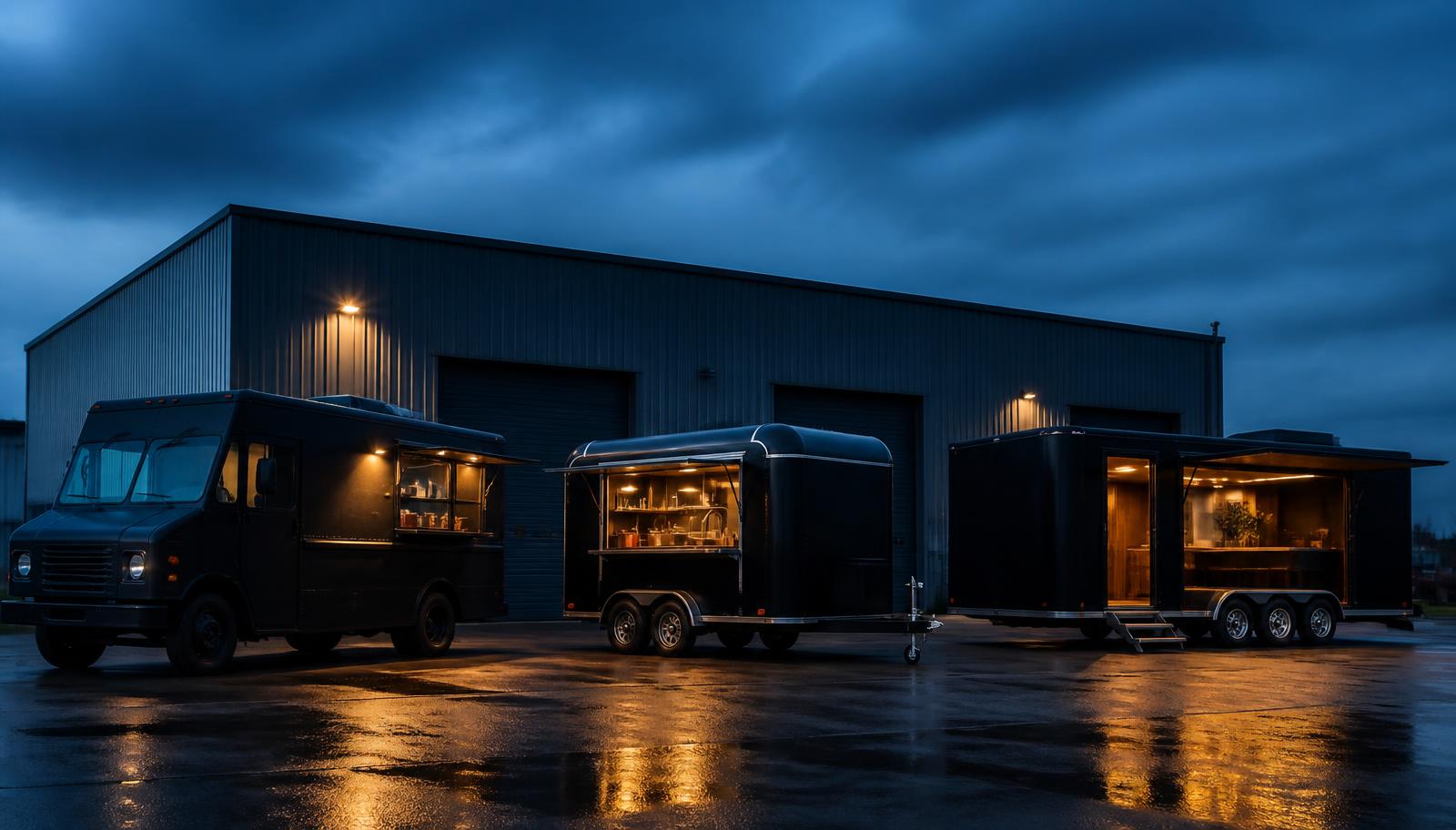
The food truck vs. food trailer decision is often reduced to one question: which one is cheaper? That question matters, but it is rarely the one that determines whether the business works. A lower purchase price can be overwhelmed by an unsuitable route, difficult site access, inadequate payload, repeated setup labor, unexpected drivetrain work, or a layout that slows every transaction.
There is also a category problem. “Food truck” and “food trailer” describe vehicle formats used for a food operation. “Mobile business trailer” describes a broader commercial platform. A coffee trailer can be both. A mobile barbershop, boutique, racing simulator, repair shop, detailing unit, or field-service workspace can be a mobile business trailer without being a food trailer at all.
Once those categories are clear, the right comparison becomes practical: How often will the unit move? How much usable workspace is required? What happens when the engine or tow vehicle needs repair? What does the fully loaded combination weigh? Where can it park? And can the operating model be repeated when the business adds a second unit? If you are still at the concept stage, start with how to start a mobile business.
First, Define the Three Platforms
Food truck
A food truck is a self-propelled motor vehicle with a kitchen or service build integrated into the vehicle. The cab, engine, drivetrain, chassis, utilities, equipment, inventory, and customer-facing operation travel as one asset.
Food trailer or concession trailer
A food trailer is a towable unit built or converted for food preparation, beverage service, concession sales, or a related hospitality use. It has no self-propelled drivetrain and requires a correctly rated tow vehicle, hitching equipment, and safe operating practices.
Mobile business trailer
A mobile business trailer is a purpose-built towable commercial workspace. The term includes some food and beverage trailers, but it also covers retail, personal services, entertainment, hospitality, repair, cleaning, detailing, mobile tire service, and field support. The defining feature is not a menu — it is a trailer configured around the work, customer flow, equipment, utilities, and brand.
Side-by-Side Comparison
| Decision factor | Food truck | Food trailer | Mobile business trailer |
|---|---|---|---|
| Core format | Self-propelled food operation. | Towable food or beverage operation. | Towable commercial workspace; food may be one use among many. |
| Best movement pattern | Multiple stops or frequent repositioning when local parking works. | One primary destination per day, events, recurring sites, or longer dwell times. | Appointments, events, routes, service territories, or repeatable fleet deployment. |
| Workspace | Cab and drivetrain consume part of the overall footprint. | More of the body can be allocated to the operation. | Layout organized around workflow, customers, equipment, storage, and utilities. |
| Propulsion | Integrated engine and drivetrain. | Separate compatible tow vehicle required. | Separate compatible tow vehicle required. |
| Repair exposure | A drivetrain repair can sideline both transportation and workspace. | Tow vehicle and workspace can often be serviced separately. | Separation supports equipment service, redeployment, and fleet continuity. |
| Site footprint | One vehicle, but cab length and parking geometry still matter. | Longer while connected; may be compact once dropped, if the site allows. | Depends on size, access, setup, circulation, and whether the tow vehicle stays. |
| Setup | Often faster for short stops; parking, leveling, and utilities still apply. | Hitching, stabilizing, leveling, and utility setup add time. | Varies by use; service and customer-facing concepts may remain deployed longer. |
| Permits | Food, fire, business, location, and vehicle rules may apply. | Similar activity rules plus trailer, towing, and site requirements. | Rules follow the activity, people, unit, site, transport combination, and event. |
| Scaling | Every unit includes another engine, drivetrain, and chassis spec. | A repeatable trailer spec can be paired with compatible tow assets. | Strong fit for master specs, branded fleets, franchises, and operating teams. |
| Best fit | Route-heavy food concepts that gain value from quick moves. | Food and beverage operators prioritizing workspace and mechanical separation. | Operators who need a purpose-built experience, service platform, or system. |
No column wins every row. A compact food truck can be ideal for three office stops in one lunch period. A trailer may be better for a brewery residency, wedding, weekend market, or coffee route with a single morning location. A purpose-built business trailer becomes especially compelling when customers enter the unit, the work requires specialized zones, or a growing company wants the next build to behave like the first.
The Food Truck: Fast Repositioning in One Integrated Asset
The food truck's strongest advantage is integration. The operator starts the vehicle, moves to the next approved location, parks, completes setup, and opens. There is no separate tow vehicle to select or trailer to hitch. For a business built around multiple short stops, that can be a meaningful operating advantage.
Where a food truck can be the right choice
The route requires several moves in a day and the revenue from those moves exceeds the labor and fuel they consume. Target locations accommodate the truck's length, height, turning radius, service window, utility setup, and customer line. The menu and equipment fit comfortably within the available payload and interior geometry. And the operator is prepared to maintain a commercial chassis as well as the business equipment.
The tradeoffs to price honestly
The engine and workspace are inseparable. If the truck needs drivetrain, emissions, brake, or chassis service, the entire revenue-producing unit may be unavailable. Used units add another layer of uncertainty because the buyer is evaluating both a commercial kitchen and a vehicle with its own age, mileage, maintenance history, modifications, and parts availability.
The Food Trailer: Separate the Business from the Drivetrain
A food trailer separates the commercial workspace from the vehicle that moves it. That structural difference affects layout, maintenance planning, site footprint, acquisition budget, insurance questions, and the long-term replacement cycle. For many operators it is the central reason to consider a concession trailer over a food truck.
A trailer fits when the business usually travels to one destination and stays for a meaningful service window, when the operation benefits from allocating more of the body to equipment and staff movement, and when the owner has — or is prepared to acquire — a properly rated tow vehicle. Events, private-property placements, recurring residencies, catering, and markets all reward that model.
The tradeoff: a trailer does not move itself. Safe towing begins with the actual trailer rating, actual loaded weight, hitch and brake requirements, tow-vehicle ratings, axle and tongue loads, route, driver capability, and state rules. The empty brochure weight is not the operating weight after water, food, equipment, batteries, fuel, supplies, and inventory are aboard.
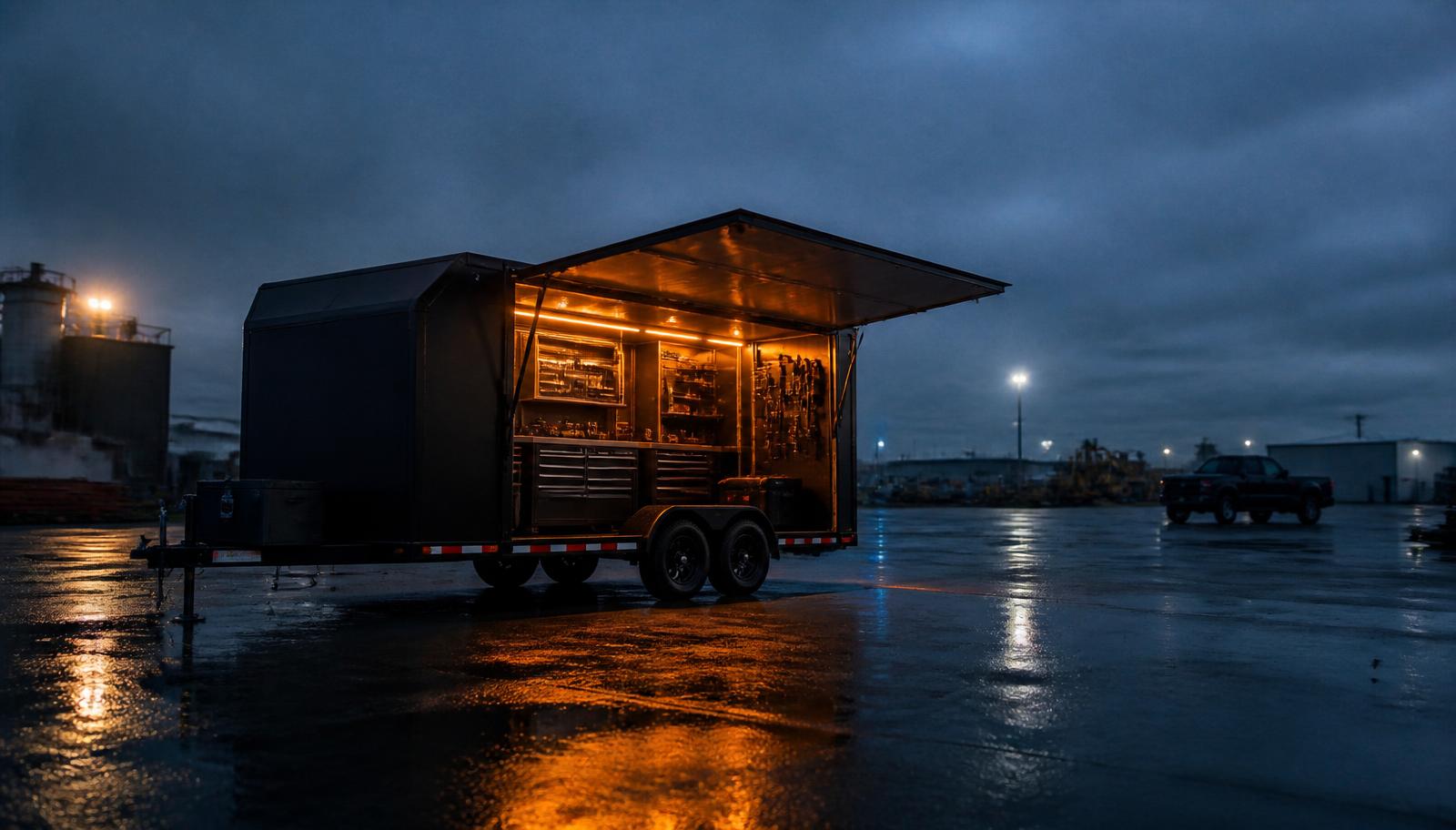
The Mobile Business Trailer: A Platform Designed Around the Work
The mobile business trailer expands the discussion beyond food. Instead of beginning with a conventional vehicle category and forcing the operation into it, the design begins with the customer experience and the work: What happens inside? Who enters? Which equipment must be secured? Where do clean and dirty processes occur? How are power, water, ventilation, climate control, storage, data, lighting, and branding integrated?
That framework can support coffee, beverages, retail, grooming, entertainment, hospitality, or field service. A mobile mechanic may need tool storage, compressed air, power, water, and exterior work access. A detailing or pressure-washing team may prioritize tanks, reels, chemical storage, and fast deployment. A boutique may prioritize product display and customer circulation. See how each of those translates into a real configuration on the Venture Works trailer lineup.
The tradeoff is that purpose-built value depends on purpose. A specialized trailer requires clear operating assumptions before design. A beautiful layout that ignores loaded weight, service access, throughput, climate, storage, or the work sequence can still fail. Customization should remove friction from a validated business model, not disguise an untested one.
The Deciding Variable: How Often Will the Business Move?
| Operating pattern | Platform tendency | What to test |
|---|---|---|
| Several short stops per day | Food truck often has the movement advantage. | Parking, setup time, route density, sales per stop, traffic, and legal vending locations. |
| One destination per day | Food trailer or mobile business trailer often becomes more attractive. | Tow compatibility, access, connected length, setup labor, utilities, and overnight storage. |
| Private events and catering | Trailer frequently fits longer dwell time and destination-based revenue. | Arrival window, organizer rules, surface, guest flow, power, water, breakdown, travel fees. |
| Appointments or on-site service | Purpose-built business trailer turns travel into a booked service environment. | Customer access, job duration, equipment deployment, waste, security, turnaround time. |
| Recurring residency | Trailer can preserve a dedicated workspace while the tow vehicle works elsewhere. | Site agreement, local permission, storage classification, utility arrangement, security. |
The reverse is also true. If a truck moves only once a week, the business may be carrying an engine, drivetrain, maintenance schedule, and integrated repair risk without earning much value from rapid relocation. The correct platform is the one whose mobility pattern matches how customers actually buy.
Downtime Is a Cost — Even When It Is Missing from the Quote
A truck repair can remove transportation, kitchen, inventory, customer service, and brand presence at the same time. With a trailer, a tow-vehicle repair may be easier to isolate if another compatible, insured, properly rated tow vehicle can be arranged. The trailer itself can still have axle, brake, bearing, tire, electrical, plumbing, appliance, generator, HVAC, and structural service needs — separation reduces one type of dependency rather than eliminating maintenance.
Compare Total Cost of Ownership, Not Sticker Price
Online cost ranges are wide because size, age, chassis condition, equipment, code requirements, fabrication quality, utilities, finish, and local market conditions vary. A basic shell, a used food truck, a fully equipped kitchen, and a premium customer-facing trailer are not comparable purchases. Build the cost model from the operating specification outward.
| Cost category | Food truck questions | Trailer questions |
|---|---|---|
| Platform and build | New or used chassis? Conversion quality? Mileage, maintenance history, equipment condition? | Shell or completed build? Size, axles, equipment, utilities, finish, and customization? |
| Transportation asset | Chassis, engine, drivetrain, tires, brakes, emissions systems, commercial service access. | Existing or new tow vehicle, hitch, brake controller, ratings, tires, brakes, driver readiness. |
| Financing | Loan structure, vehicle age limits, down payment, term, collateral, working capital. | Trailer and tow vehicle may be financed separately; confirm lender, title, and collateral rules. |
| Insurance and registration | Commercial auto, business property, liability, workers' compensation, local requirements. | Trailer, tow vehicle, property, liability, workers' comp, attached and detached use. |
| Fuel and utilities | Driving fuel plus generator, propane, shore power, batteries, and water. | Tow fuel plus the same business utility sources appropriate to the build. |
| Maintenance | Vehicle systems and commercial equipment share one asset and schedule. | Tow vehicle, running gear, structure, and equipment have separate service needs. |
| Storage and parking | Secure, legal parking with commissary, charging, cleaning, or service access. | Secure trailer storage plus space for the tow vehicle and connected combination. |
| Permits and inspections | Business, food/service, fire, unit, vehicle, location, and event approvals. | Similar approvals plus trailer, tow-combination, and site-specific considerations. |
| Downtime and replacement | What happens to revenue when the chassis or workspace is unavailable? | Can transport and workspace be repaired or replaced independently? |
| Resale or redeployment | Value depends on chassis and build condition together. | Can the workspace be updated, rebranded, repurposed, or paired with a different tow asset? |
Fees, fuel, insurance, marketing, software, repairs, and slow opening weeks still exist after the keys are handed over. For a funding framework, read how to finance a mobile business trailer. For a concept-level cost breakdown, read how much a mobile coffee trailer costs.
Workspace, Payload, and Utility Capacity
A larger exterior does not automatically create a better business. Usable workspace is the area that supports safe, fast, repeatable work after equipment clearances, employee movement, customer access, storage, utility systems, tanks, service panels, ventilation, and required separation are accounted for.
Build a loaded-weight worksheet
Record the manufacturer's ratings for the truck, trailer, axles, tires, hitch, and tow vehicle; do not infer one rating from another. List installed equipment and its location, then add maximum water, fuel, batteries, inventory, supplies, tools, people where applicable, and expected cargo. Verify the completed unit on appropriate scales and compare actual axle and combination weights with all applicable ratings.
Permits Follow the Activity, Unit, Site, and Route
A trailer is not a permit shortcut. A food truck and food trailer performing the same operation may face similar food-safety, plan-review, fire, business, employee, commissary, waste, and location requirements. Vehicle registration, towing, parking, street-vending, event, and site rules can differ because the physical formats differ.
Nonfood mobile business trailers are still regulated according to what happens inside and where they operate. A barbershop, retail store, entertainment venue, repair unit, or mobile service operation can trigger professional licensing, sales-tax, zoning, fire, environmental, accessibility, employee-safety, wastewater, noise, or event requirements. There is no universal “mobile business permit” that replaces those layers — see the full process in permits and licenses for a mobile business.
Towing and Commercial-Vehicle Rules Need Their Own Review
A trailer creates a vehicle combination, and the relevant thresholds are not always based on what the trailer happens to weigh on one trip. Manufacturer ratings, actual weights, vehicle use, intrastate or interstate operation, state law, and federal definitions can all matter. Give the state motor-vehicle authority the exact ratings, actual use, operating territory, ownership, and cargo information — do not treat a memorable number from an online discussion as a universal rule.
Branding and Customer Experience
All three platforms can become strong brand assets. A food truck is immediately recognizable and generates visibility on a route. A trailer can create a shopfront-like presence at an event or recurring site. A purpose-built business trailer extends the experience inside through lighting, materials, displays, service stations, seating, technology, sound, and climate control.
The right question is not which platform has the largest graphic surface. It is how the customer discovers, approaches, enters or orders from, waits at, pays, receives service from, and remembers the unit. Design the sequence deliberately: discovery, approach, transaction, delivery, and recovery — including whether staff can reset, restock, and clean without crossing paths with the next customer.
Which Platform Scales Better?
Scale is not simply adding another vehicle. The second unit must reproduce quality, throughput, safety, training, customer experience, service access, and financial performance. Food trucks can scale, especially when the route model requires self-propelled units, but each unit adds a chassis procurement, drivetrain service, and vehicle lifecycle decision. Trailers support a different fleet architecture: a documented master build, controlled option packages, repeated work zones, common equipment, and compatible tow assets.
| Scaling question | Why it matters |
|---|---|
| Can the same layout be built again? | Repeated ergonomics simplify training, staffing, documentation, and performance comparison. |
| Are equipment and service parts standardized? | Common components reduce spare-parts variety and help technicians diagnose faster. |
| Can propulsion and workspace be replaced separately? | Lifecycle planning is easier when the workspace is not tied to one drivetrain. |
| Which options are truly local? | Climate, menu, service type, and jurisdiction may require controlled variation. |
| Is there a master specification? | A governed spec protects the operating system from drifting with each new order. |
A Simple Decision Framework
Choose a food truck when…
Frequent, rapid repositioning is essential to the revenue model; the route and legal parking network consistently accommodate the truck; the operation fits the available interior and payload; and the business is prepared for commercial-vehicle maintenance and integrated downtime.
Choose a food trailer when…
The business is food or beverage focused and usually serves one destination for a longer period; workspace and mechanical separation matter more than fast repositioning; a properly rated tow vehicle, trained driver, storage plan, and suitable sites are available; and events, catering, markets, or recurring placements drive demand.
Choose a purpose-built mobile business trailer when…
The concept extends beyond food or requires a specialized customer-facing environment; the workflow depends on integrated utilities, equipment, storage, technology, or service zones; the trailer must function as a brand destination, shop, service bay, or field asset; and the company expects to repeat the specification across locations, teams, franchises, or a service fleet. That is the case we make in why mobile beats brick-and-mortar.
Eight Questions to Answer Before Requesting a Quote
1. How many times will the unit move on a normal day? Map a real week, including storage, restocking, events, appointments, fueling, cleaning, and service.
2. How long will it remain at each destination? Short stops reward fast repositioning; long dwell times can justify more setup in exchange for better workspace.
3. What exactly happens inside and outside? Write the work sequence from arrival through close — people, equipment, storage, clean and dirty processes, circulation, and reset time.
4. What will the completed unit weigh? Build a realistic loaded-weight worksheet and select the tow combination from manufacturer ratings.
5. Which sites can physically and legally support it? Check turning path, surface, slope, clearance, connected length, queue space, utilities, noise, hours, and fire access.
6. What is the downtime plan? Identify repair vendors, service intervals, spare parts, alternate transportation, rescheduling rules, insurance, and cash reserves.
7. What does the first year cost after purchase? Model financing, insurance, registrations, permits, fuel, storage, maintenance, utilities, inventory, payroll, marketing, site fees, taxes, and working capital.
8. Will the business add another unit? If growth is plausible, document the master workflow, component choices, option rules, training standards, and performance metrics before the first build becomes a one-off.
Common Buying Mistakes
Choosing by purchase price alone. Comparing unlike builds. Ignoring fully loaded weight. Underestimating maneuvering and setup. Buying a used truck without two separate inspections — one for the chassis, one for the build. Assuming a trailer avoids permits. Oversizing the unit. Designing for every possible menu or service. Skipping the continuity plan. And treating the first unit as an art project instead of a documented operating system.
Why Venture Works Builds Mobile Business Trailers
Venture Works focuses on purpose-built trailers because separating the commercial workspace from the propulsion asset can create a durable operating advantage. The interior can be configured around the business, the exterior can become a brand destination, and the workspace can be maintained, updated, rebranded, or repeated without tying every decision to one engine and chassis.
That approach supports food and hospitality concepts like THE MORNING RUSH coffee trailer and THE TAPHOUSE beverage trailer, as well as retail, grooming, entertainment, lounge, and custom configurations. It also extends to service operations: THE WORKHORSE is designed for mobile mechanic, cleaning, pressure washing, and detailing work where organized tools, power, air, water, storage, and repeatable deployment matter. Compare every configuration on the trailers page, or see what the day-to-day actually looks like in the dream.
A trailer is not automatically the right answer. If the business must make many short moves every day and can operate efficiently from a compact self-propelled unit, a food truck may be the better tool. Our role is to help operators who benefit from a towable, purpose-built workspace translate a validated business model into a durable mobile platform.
Final Takeaway
The best mobile platform is not the one with the lowest advertised price or the most impressive equipment list. It is the one that serves the route, fits the sites, carries the completed load, supports the workflow, survives maintenance, clears the required approvals, creates a strong customer experience, and can be financed without starving the business of working capital.
Frequently Asked Questions
Common Questions
- Is a food trailer cheaper than a food truck?
- Sometimes, but not automatically. A trailer may avoid purchasing an integrated commercial chassis, while a truck does not require a separate tow vehicle. Equipment, fabrication, utilities, condition, permits, insurance, financing, storage, and working capital can outweigh the format difference. Compare complete, operating-ready systems and first-year total cost.
- Which is easier to drive: a food truck or food trailer?
- Many drivers find an integrated truck more familiar at first, while towing requires specific skills for hitching, braking, turning, backing, clearance, and managing a longer combination. Large trucks also require commercial-vehicle awareness. The answer depends on dimensions, ratings, driver training, route, and local licensing requirements.
- Do food trailers need the same permits as food trucks?
- They can share many food, fire, business, employee, commissary, event, and location requirements because those rules follow the activity. Trailer registration, towing, parking, and site rules may differ. The responsible local and state agencies must classify the actual unit and operation.
- Do I need a tow vehicle before buying a food trailer?
- You need a verified transportation plan before operation, and it should influence trailer selection. Choose the tow vehicle from the completed trailer's ratings, loaded weight, hitch requirements, route, and manufacturer guidance — not from empty weight or a generic towing claim.
- Can I leave a food trailer at a business or event site?
- Only if the property agreement, organizer rules, zoning, vending or site approvals, storage rules, security plan, utilities, fire access, insurer, and other applicable requirements allow it. Written property permission alone may not authorize the use.
- Which has more usable workspace?
- A trailer can often devote more of its body to the commercial operation because it does not contain a cab and drivetrain. Actual usable space depends on dimensions, wheel wells, equipment, utility systems, service clearances, customer access, code requirements, and the layout — not the category name alone.
- Is a food truck or food trailer easier to finance?
- It depends on the borrower, asset age and condition, lender, down payment, collateral, title, equipment, term, and whether a tow vehicle is included. Some lenders are comfortable with vehicle collateral; others specialize in equipment or trailers. Compare monthly debt service with working-capital needs and the asset's expected useful life.
- Is a used food truck better than a new food trailer?
- Neither is universally better. A used truck may offer a faster or lower-cost entry, but the vehicle and commercial build each require qualified inspection. A new trailer can provide a purpose-built layout and known fabrication history, but it still needs a tow vehicle, approvals, and a complete operating budget.
- Which platform is best for festivals and private events?
- Trailers often fit destination-based events because they offer substantial workspace and can remain deployed for the service window. Trucks can be excellent when the organizer favors self-propelled units or fast movement. Confirm vendor rules, arrival and departure windows, ground conditions, connected length, power, water, fire requirements, and customer flow.
- What is a mobile business trailer?
- It is a towable commercial workspace purpose-built around a business activity. It may contain a kitchen or coffee operation, but it can also support retail, barbering, entertainment, hospitality, repair, detailing, cleaning, field service, and other customer-facing or operational uses.
- Can a mobile business trailer serve food?
- Yes. A purpose-built coffee, beverage, concession, or food trailer can also be a mobile business trailer. It must still satisfy the food-safety, plan-review, fire, equipment, water, wastewater, commissary, operator, site, and event requirements that apply in its jurisdictions.
- Which platform is best for a franchise or service fleet?
- The answer depends on the route. If frequent self-propelled movement is essential, trucks may fit. If the company values a repeatable workspace, common components, controlled options, separate transport assets, and long on-site work periods, purpose-built trailers can provide a strong fleet architecture.