Location Strategy / July 31, 2026
How to Find Profitable Locations for a Mobile Business
A practical way to turn customer demand, site economics, route density, permissions, and live operating data into a profitable mobile schedule.
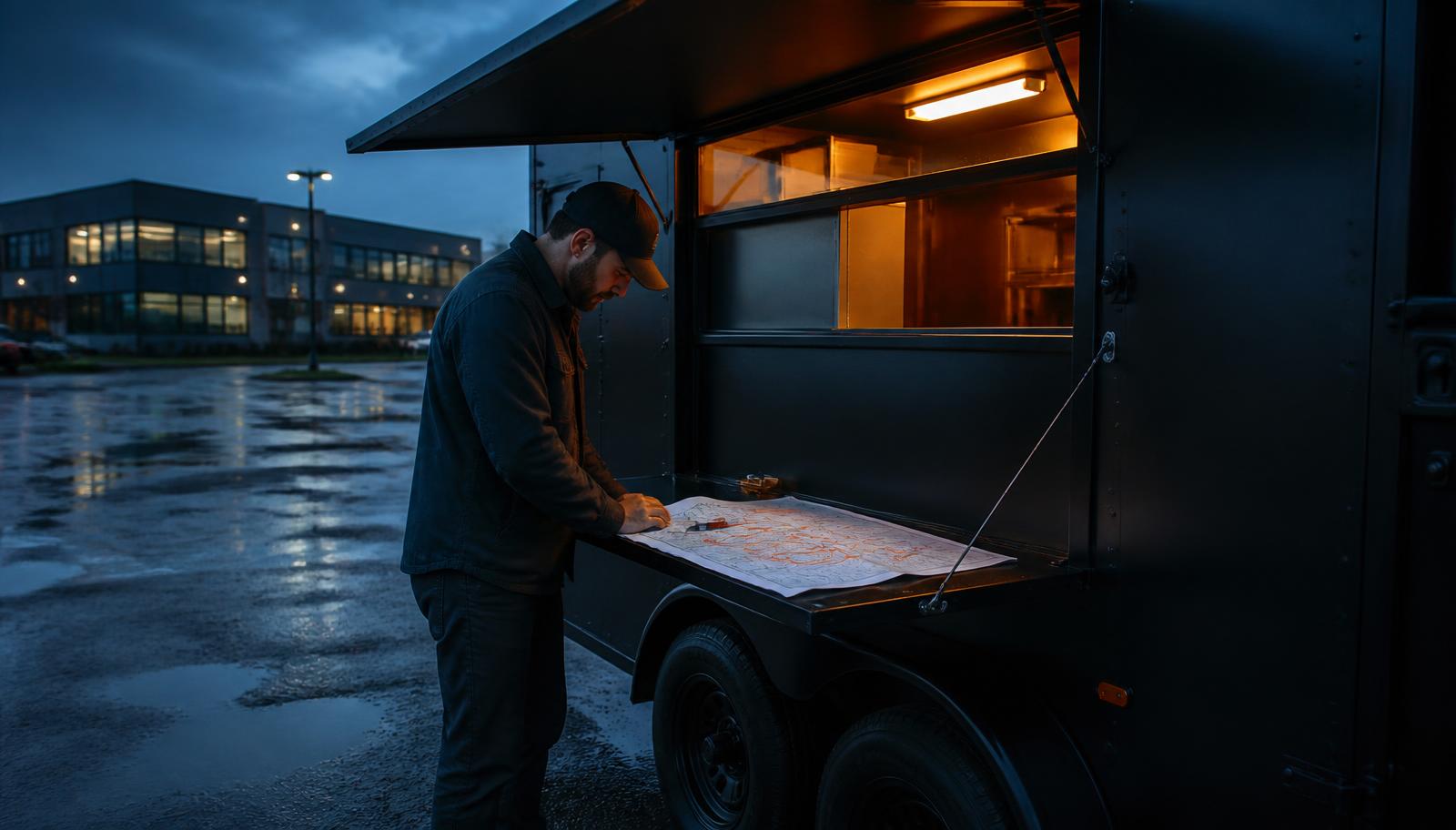
The best location is not always the busiest place. It is the place where the right customers, operating window, site costs, permissions, and workflow combine to produce dependable contribution.
A crowded festival can generate impressive revenue and disappointing profit. A quiet office park can look unremarkable and produce a reliable weekly route. A mobile detailing or repair business may not need foot traffic at all; its best “location” may be a cluster of fleet accounts that keeps technicians working while reducing unpaid travel.
That is why “go where the people are” is incomplete advice. A profitable location has enough of the right demand, at the right time, with workable access, manageable site costs, a legal path to operate, and a format the mobile unit can serve efficiently. It also has to fit the rest of the schedule. A strong stop located 70 minutes from the next job may weaken the day around it.
Mobility makes location testable. Instead of signing a long lease and waiting for one trade area to prove itself, an operator can compare sites, days, event types, customer groups, and service territories with real data. That is one of the core arguments in why mobile beats brick-and-mortar. The advantage belongs to the owner who treats the calendar as a portfolio — not to the owner who drives around hoping to find a crowd.
What Does a “Location” Mean for a Mobile Business?
For a mobile business, location is broader than a parking space. It is the combination of geography, customer group, time window, commercial arrangement, and operating purpose that creates an opportunity to earn.
| Location model | How demand appears | Examples |
|---|---|---|
| Transaction site | Customers buy during an open service window; visibility, convenience, conversion, and throughput matter. | Office park, hospital campus, industrial shift change, brewery, apartment community, market, or shopping area. |
| Recurring host site | A property owner, employer, community, or complementary business brings a repeat audience. | Weekly employer stop, monthly HOA night, gym partnership, dealership residency, or scheduled neighborhood route. |
| Booked destination | Revenue is contracted or reserved before arrival; the location enables delivery rather than discovery. | Wedding, corporate event, festival package, private party, school event, brand activation, or mobile appointment. |
| Service territory or job cluster | Customers are reached through appointments, contracts, dispatch, or account routes; density drives utilization. | Fleet maintenance, mobile tire service, detailing, pressure washing, repair, cleaning, tint, or field support. |
A Profitable Location Is More Than High Traffic
Raw traffic counts people or vehicles. Qualified demand counts people who fit the customer profile, are present during the operating window, can safely reach the unit, understand the offer, have enough time to buy, and are willing to pay the price. Those are different numbers.
A morning coffee trailer needs concentrated demand before work, between shifts, or during a campus routine. A mobile boutique needs shoppers with time and interest to browse. A barbershop needs appointment density, trust, privacy, and a schedule customers can remember. A simulator or lounge may earn far more from a booked four-hour event than from an entire day of casual foot traffic. THE WORKHORSE may create its best economics at a fleet yard where ten vehicles can be serviced without moving the trailer.
Evaluate five forms of fit
| Form of fit | The question it answers |
|---|---|
| Customer fit | Are enough of the right people or accounts present — and do they have the problem the business solves? |
| Time fit | Does their buying or service window match the hours the unit can operate profitably? |
| Site fit | Can the trailer enter, turn, park, level, deploy, receive customers, and leave without creating friction or risk? |
| Economic fit | Will sales or booked revenue exceed site-specific product, labor, travel, fee, and operating costs by enough to justify the time? |
| Permission fit | Do the property arrangement, zoning, licenses, permits, event rules, insurance, and activity-specific approvals allow the actual operation? |
If one form of fit fails, traffic may not matter. A visible curb with no legal vending path is not a location. A profitable event that ties up three days of preparation and recovery may be weaker than its sales suggest. A fleet account at the edge of the territory may be worth accepting only if it anchors additional jobs nearby.
Start With the Customer and Buying Occasion
The U.S. Small Business Administration recommends answering questions about demand, market size, customer location, market saturation, and pricing. For a mobile operator, add time and occasion. The same person may buy coffee near work at 7:30 a.m., visit a market with family on Saturday, book grooming near home, and authorize fleet service at a commercial yard. Those are four different location opportunities.
Write a location hypothesis
Use one sentence: “We believe [customer] will buy [offer] at [site or territory] during [time or occasion] because [specific unmet need], producing at least [economic threshold].” The threshold might be transactions, booked revenue, contribution per deployed hour, minimum jobs per route, or repeat reservations.
The hypothesis makes the test useful. If sales disappoint, the operator can ask whether the problem was customer count, timing, offer, awareness, price, weather, service speed, host promotion, or site access. “This location did not work” is a conclusion. “Only 22% of the expected shift was present because the employer used a hybrid schedule” is information.
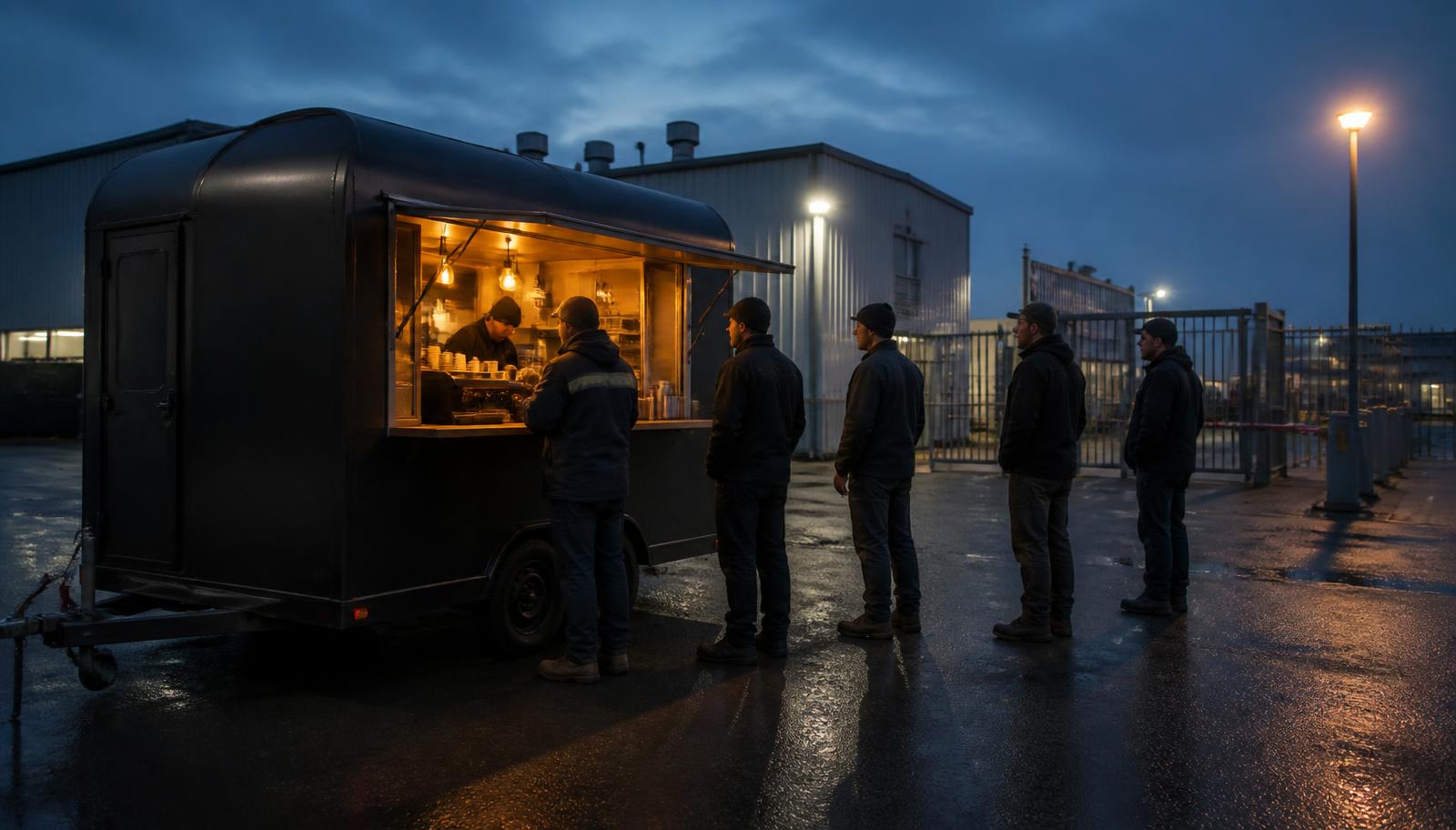
Where to Look: Candidate Pools by Business Model
| Mobile concept | Promising location pools | What creates value |
|---|---|---|
| Coffee and espresso | Employers, hospitals, industrial parks, campuses, apartments, gyms, breweries, markets, weddings, and catered meetings. | Compressed morning demand, limited nearby options, repeat schedule, fast service, and host communication. |
| Bar and beverage | Weddings, private venues, festivals, corporate events, fundraisers, pop-ups, and branded activations. | Booked revenue, package pricing, guest count, host fit, compliant service model, and event logistics. |
| Retail and boutique | Markets, festivals, neighborhoods, salons, wineries, campuses, resorts, product drops, and partner events. | Audience-product fit, browsing time, fitting experience, merchandising, and complementary hosts. |
| Barber and personal service | Employers, apartments, senior communities, campuses, events, neighborhoods, and recurring appointment routes. | Appointment density, convenience, privacy, schedule reliability, and repeat frequency. |
| Gaming and entertainment | Schools, parties, festivals, corporate events, youth sports, fairs, resorts, and brand activations. | Advance bookings, participant capacity, session length, power, connectivity, supervision, and weather protection. |
| Lounge and hospitality | Weddings, festivals, sporting events, VIP areas, production sites, green rooms, and premium rentals. | Package value, climate control, presentation, guest capacity, venue access, and utilization. |
| Mobile service and repair | Fleet yards, dealerships, rental operators, contractors, warehouses, apartment portfolios, commercial properties, and service territories. | Jobs per deployment, asset density, reduced customer downtime, contract value, and route efficiency. |
Use this table to generate possibilities, not to declare a winner. A hospital may have exceptional daily population and a restrictive vendor process. A brewery may welcome food partners but already rotate eight competing vendors. A fleet yard may look ideal on a map but have no safe trailer placement near the work. Every candidate still needs qualification. Each of the eight Venture Works configurations is built around a different one of these demand patterns.
Build the Candidate List in Four Passes
1. Map the market
Start at the territory level. Census Business Builder provides demographic, socioeconomic, and business information with maps and reports. OnTheMap shows where workers are employed and where they live, which is especially useful when daytime population matters more than residential population. These tools reveal patterns; they do not predict a specific trailer's sales.
Layer in target employers, fleet concentrations, apartment density, campuses, hospitals, event venues, complementary businesses, competitors, roads, travel times, storage, and operating jurisdictions. For a service business, map customer assets and job value rather than consumer population alone.
2. Observe the location in person
Visit during the exact proposed operating window. Count the relevant people or vehicles, not everyone who passes. Watch where they enter, park, queue, take breaks, wait, and leave. Note whether traffic moves too quickly to stop, whether pedestrians can see the service side, whether delivery vehicles block access, and whether the site's busiest period conflicts with trailer setup.
3. Ask the host and customer
A property manager knows resident events. An HR leader knows shift counts and attendance patterns. A fleet manager knows which assets create downtime and how many are on-site by day. A venue knows guest count, vendor history, access windows, power, and cancellation patterns. Customer interviews add information maps cannot provide: what they buy now, what frustrates them, what they would pay, and how often they would use the service.
4. Test with a controlled offer
Run a pop-up, preorder window, appointment block, sample day, demonstration, or paid pilot before promising a long residency. Keep the offer and hours consistent enough to compare results. For a fleet-service concept, test one account or one defined service package and measure technician utilization, job completion, customer downtime, travel, and follow-on demand.
Use a Location Scorecard Before Negotiating
A scorecard does not replace judgment. It prevents excitement about one visible feature — crowd size, a famous venue, or a prestigious account — from hiding weak economics or difficult operations. Adjust the weights to the business model, then use the same version for every candidate.
| Criterion | Illustrative weight | Questions to score |
|---|---|---|
| Qualified demand | 20% | How many likely buyers, booked guests, vehicles, assets, or jobs are present during the usable window? |
| Revenue potential | 15% | What transaction volume, package value, appointment density, or contract revenue is realistic? |
| Site-level contribution | 15% | What remains after variable product, fee, labor, travel, utility, and location-specific costs? |
| Access and workflow | 10% | Can the unit enter, turn, park, level, deploy, operate, serve, restock, and leave efficiently? |
| Permission and compliance | 10% | Is there a credible path through property, zoning, licensing, permit, event, fire, health, and insurance requirements? |
| Route fit | 10% | How much travel, deadhead time, setup, and schedule fragmentation does the location create? |
| Repeatability | 10% | Can the site or account recur on predictable terms with a reliable customer base? |
| Host partnership | 5% | Will the host promote, coordinate, communicate, reserve space, and resolve on-site issues? |
| Risk and resilience | 5% | How exposed is the location to weather, cancellations, construction, leadership changes, seasonality, or one customer? |
Measure Contribution, Not Just Revenue
| Metric | Formula | Why it matters |
|---|---|---|
| Site contribution | Revenue − site-specific variable and incremental costs | Shows what the deployment contributes toward fixed overhead and profit. |
| Contribution per open hour | Site contribution ÷ customer-facing operating hours | Measures the economics of the service window itself. |
| Contribution per deployed hour | Site contribution ÷ travel, setup, open, teardown, and recovery hours | Makes a nearby recurring stop comparable with a distant event or scattered route. |
| Break-even transactions | Site-specific fixed costs ÷ contribution per transaction | Estimates the minimum sales count before the deployment contributes anything. |
| Revenue per mile | Deployment revenue ÷ total trip miles | Helps identify routes weakened by long unpaid travel. |
| Utilization | Revenue-producing time ÷ total available or deployed time | Especially useful for appointment, service, rental, and entertainment concepts. |
Illustrative transaction-site calculation
| Illustrative line | Amount |
|---|---|
| 90 transactions × $9.50 average ticket | $855 |
| Product, packaging, and payment costs | − $315 |
| Site fee | − $125 |
| Incremental labor | − $180 |
| Travel, fuel, and site-specific operating costs | − $45 |
| Illustrative site contribution before fixed overhead | $190 |
Run the same math against your capital plan. If you are still sizing the investment, see how much a mobile coffee trailer costs and how to finance a mobile business trailer.
Permission Is a Separate Location Test
Property-owner permission is necessary for many private sites, but it may not be sufficient. Our guide to mobile business permits and licenses explains the broader permission stack: the business, activity, operator, unit, location, event, and ongoing operation can each be controlled by different agencies or agreements. The SBA also notes that location affects zoning, taxes, licenses, and regulations.
Before announcing a stop, confirm the actual parcel and operating pattern with the responsible city, county, health, fire, professional, alcohol, environmental, motor-vehicle, tax, and event authorities as applicable. A trailer that can operate in one city may need a separate approval, inspection, tax setup, or vending path in another. Public right-of-way, private property, parks, and temporary events may be treated differently.
Document the site arrangement
| Category | What to put in writing |
|---|---|
| Placement and term | Exact address, placement area, permitted activity, dates, hours, arrival, departure, and renewal term. |
| Money | Host fee, percentage, minimum, deposit, payment timing, refunds, taxes, and who bears event or utility charges. |
| Site logistics | Access, gates, parking, queue, restrooms, power, water, wastewater, waste, internet, security, and weather alternatives. |
| Marketing | Marketing responsibilities, employee or resident communication, signage, exclusivity, competing vendors, and minimum host participation. |
| Risk terms | Insurance, certificates, indemnity, damage, cancellation, force majeure, permit responsibility, termination, and dispute terms for professional review. |
The Host Partnership Can Be Worth More Than the Parking Space
The best recurring hosts do more than allow a trailer to occupy a corner. They concentrate the right audience, communicate the schedule, reserve the site, share access information, provide an on-site contact, and help the operator understand demand. That lowers customer-acquisition cost and operating uncertainty.
Lead with the host's outcome. An employer may want a retention amenity without managing a cafeteria. An apartment operator may want resident programming. A brewery may want food that increases guest dwell time. A fleet manager may want less asset downtime and fewer trips to a shop. A dealership may want on-site support capacity. Frame the mobile business as a solution to that outcome, then propose a low-risk pilot.
Questions for a prospective host
| Ask | Why it matters |
|---|---|
| How many relevant employees, residents, guests, vehicles, or customers are present during the proposed window? | Converts assumed traffic into qualified demand. |
| What have previous vendors or service partners learned about demand, timing, pricing, access, and promotion? | Free operating history you would otherwise pay to learn. |
| Who controls the site, and which internal, landlord, municipal, venue, or event approvals are required? | Reveals whether the person you are talking to can actually say yes. |
| What will the host communicate before the pilot, and through which channels? | A private audience will not discover the trailer on its own. |
| Which outcomes would make the host invite the business back? | Defines the standard your pilot has to hit. |
Test Locations Like Experiments
One strong day does not prove a location, and one rainy day does not disprove it. Design a test that separates location quality from launch excitement, weather, novelty, promotion, or an unusual event calendar.
| Step | What to do |
|---|---|
| 1. Set the pass/fail gates | Confirm permission, access, safety, utilities, insurance, and the minimum economic threshold before the test. If a gate fails, do not use a weighted score to rationalize it. |
| 2. Define the hypothesis and forecast | Record expected customer count or jobs, conversion, average ticket or contract value, variable costs, deployed hours, and contribution before results are known. |
| 3. Control the offer and window | Use a focused menu, service package, event package, or appointment block so the test stays comparable with other candidates. |
| 4. Coordinate host promotion | Provide exact date, time, location, offer, ordering or booking instructions, and access requirements. Record which channels were used and when. |
| 5. Capture operating data | Track sales or booked revenue, transactions or jobs, average ticket, product mix, service time, labor, travel, setup, downtime, fees, weather, feedback, and failures. |
| 6. Repeat enough to explain variability | Compare more than one representative date. Note day of week, season, weather, payroll cycle, shift attendance, competing events, and host promotion. |
| 7. Make a calendar decision | Keep, modify, retest, change frequency, reprice, renegotiate, move to a better window, or drop it. Assign the next date and action immediately. |
Protect Route Density and Plan for Seasonality
Map the whole day, not each location in isolation. Place recurring stops in geographic clusters. Quote travel or minimums for outlying events. Assign service days by territory. Avoid a schedule that alternates distant markets and consumes the best working hours in transit. When a remote account is strategically valuable, recruit complementary sites or jobs around it before making it a permanent route.
Track performance by season, temperature, daylight, precipitation, school calendar, tourism, employer attendance, and event cycle. Build indoor, covered, catered, corporate, appointment, or service channels that can replace weather-sensitive revenue. A location is not dependable merely because it worked in the best month of the year.
The mix should reflect the concept. A coffee operator may rely heavily on recurring morning stops. A mobile bar or lounge may be almost entirely booked. A boutique may blend markets and partner events. A service trailer may build dense account routes and reserve capacity for emergency or premium jobs. Do not copy another operator's calendar allocation without copying its margins, demand pattern, risk, staffing, and sales process.
Common Location-Strategy Mistakes
| Mistake | The correction |
|---|---|
| Confusing traffic with demand | Count the people or accounts likely to buy during the actual operating window, then measure conversion. |
| Choosing prestige over contribution | A famous festival can create high fees, long hours, and low margins. Evaluate contribution per deployed hour. |
| Tracking revenue without site-specific cost | Allocate product, payment, host, event, labor, travel, setup, utility, and waste costs consistently. |
| Ignoring the host's promotion | Agree on channels, timing, message, and responsibility before the pilot. |
| Treating verbal permission as approval | Confirm property control, zoning, permits, activity rules, insurance, and the written site arrangement. |
| Testing too many variables at once | Change one thing at a time so the result can be explained. |
| Judging from one abnormal day | Record weather, attendance, conflicts, novelty, and failures. Retest when conditions were not normal. |
| Overcommitting the calendar | Leave capacity for maintenance, recovery, high-value bookings, weather changes, and sales work. |
| Failing to build anchor locations | Constant novelty makes the business hard to find and expensive to market. Repeatable stops create habits. |
Operators sometimes keep weak stops because the host is friendly, the crowd looks busy, or the location was difficult to secure. A mobile business earns its flexibility by replacing calendar slots that consistently fail the economic and operational threshold.
Let Location Strategy Shape the Mobile Build
Location is not only a marketing decision. It is a design input. Repeated office stops may demand extremely fast opening and closing, high rush-hour throughput, preorder pickup, and minimal generator noise. Weddings may demand premium exterior presentation, quiet power, climate control, and carefully staged guest flow. Markets may require awning coverage, merchandising, security, and long off-grid operation. Fleet yards may need tool access, reels, air, water, power, exterior work zones, and storage organized around repeated service tasks.
Venture Works builds purpose-built mobile business trailers around those operating realities. THE MORNING RUSH supports coffee and espresso routes. THE TAPHOUSE, THE SOCIAL CLUB, and THE DIGITAL ARENA fit booked hospitality and entertainment. THE OUTFITTER and THE PARLOR bring retail and personal service to partner sites and appointments. THE WORKHORSE is built for mobile service, repair, cleaning, pressure washing, detailing, and fleet deployment. THE CUSTOM FIT begins with the operating model when the concept does not fit a standard category.
Final Takeaway
The best mobile business location is not simply the place with the largest crowd. It is the place where qualified demand, timing, access, site costs, permissions, host support, and route efficiency combine to create enough contribution for the time and risk involved.
Define the customer and buying occasion. Build the candidate list. Use pass/fail gates and a scorecard. Calculate site contribution and contribution per deployed hour. Run controlled tests. Secure recurring anchor locations. Keep measuring — and replace the calendar slots that do not earn their way back.
Frequently Asked Questions
Common Questions
- What are the best locations for a mobile business?
- The best locations contain enough qualified demand during a workable time window, provide safe and efficient access, clear the business's contribution threshold, fit the wider route, and have a credible legal and property-permission path. The answer may be an office park, event, apartment community, partner business, appointment cluster, or fleet yard depending on the concept.
- How do I find profitable food truck locations?
- Map target customers and daytime population, observe candidate sites during the exact service window, talk with hosts and other vendors, screen zoning and vending rules, estimate site-level costs, and run controlled tests. Track transactions, average ticket, contribution, deployed hours, weather, and repeat demand by location.
- Are high-traffic areas always best?
- No. Traffic must be qualified, accessible, and present at the right time. High-traffic sites may also have expensive fees, congestion, limited stopping time, strong competition, difficult parking, or restrictive rules. A smaller captive audience can be more profitable when conversion and repeatability are high.
- How can I find locations for a mobile coffee trailer?
- Look for concentrated morning demand and limited convenient alternatives: employers, industrial shifts, hospitals, campuses, apartments, gyms, commuter-oriented partners, events, and catered meetings. Confirm power, water, wastewater, access, generator or noise rules, host promotion, health requirements, and the throughput needed during the rush.
- Should I pay rent or a percentage of sales for a mobile location?
- Either can work. A fixed fee is predictable but creates risk on weak days. A percentage shares demand risk but can become expensive at strong sites and requires clear sales reporting. Compare the expected fee under several sales scenarios and document minimums, caps, taxes, utilities, refunds, cancellations, and included host support.
- How many times should I test a mobile business location?
- There is no universal number. Test enough representative operating windows to distinguish normal demand from weather, novelty, unusual attendance, missing promotion, or an operational failure. A booked event may be evaluated job by job; a recurring vending site may require several comparable dates.
- What should I track at each mobile business location?
- Track qualified traffic or available jobs, transactions or bookings, conversion, average ticket or job value, product mix, direct costs, site fee, labor, travel, setup, idle time, deployed hours, contribution, weather, host promotion, customer source, repeat demand, and operating exceptions.
- Can I park a mobile business on private property?
- Only when the property controller permits it and the actual activity, unit, site, parking arrangement, duration, utilities, customer access, and operating hours satisfy applicable zoning, licensing, health, fire, professional, environmental, tax, insurance, and other requirements. Private permission does not automatically override government rules.
- How do I approach an office, apartment, or property manager?
- Lead with the host's outcome, such as an employee amenity, resident event, customer draw, or reduced fleet downtime. Present the operating concept, proposed pilot window, site needs, insurance readiness, and responsibilities. Ask for the audience count, approval process, promotion plan, placement rules, and the criteria for a recurring schedule.
- What is an anchor location?
- An anchor location is a recurring, predictable stop or account that helps stabilize the calendar. It can create customer habits, simplify staffing and preparation, reduce marketing uncertainty, and improve route planning. It should still earn its place through measured economics and reliable host support.
- How does location strategy work for a mobile service business?
- Focus on account and asset density rather than foot traffic. Group customers into territories, estimate jobs and revenue per deployment, measure technician utilization and customer downtime, minimize unpaid travel, and look for fleet yards, property portfolios, dealerships, contractors, and commercial accounts that can support repeat routes.
- When should I drop a mobile business location?
- Drop or replace it when the legal path, safety, access, host behavior, route fit, or contribution consistently fails and there is no credible improvement worth testing. Document the lesson and use mobility to move the calendar toward stronger demand.